Beyond Point Solutions: Why the Next Generation of Startups Is Rebuilding Entire Systems
Innovation doesn't always mean creating something completely new.
In many cases, the biggest opportunities come from improving systems that millions of people already rely on every day. As technology evolves, industries often accumulate disconnected tools, redundant workflows, and siloed data. What starts as innovation eventually becomes complexity.
The startups that stand out today aren't simply adding another product to the mix. They're stepping back and asking a bigger question:
What if the entire experience worked as one connected system?
This week's featured companies all approach that challenge from different industries, but they share the same philosophy: reduce friction, eliminate fragmentation, and create a more unified experience.
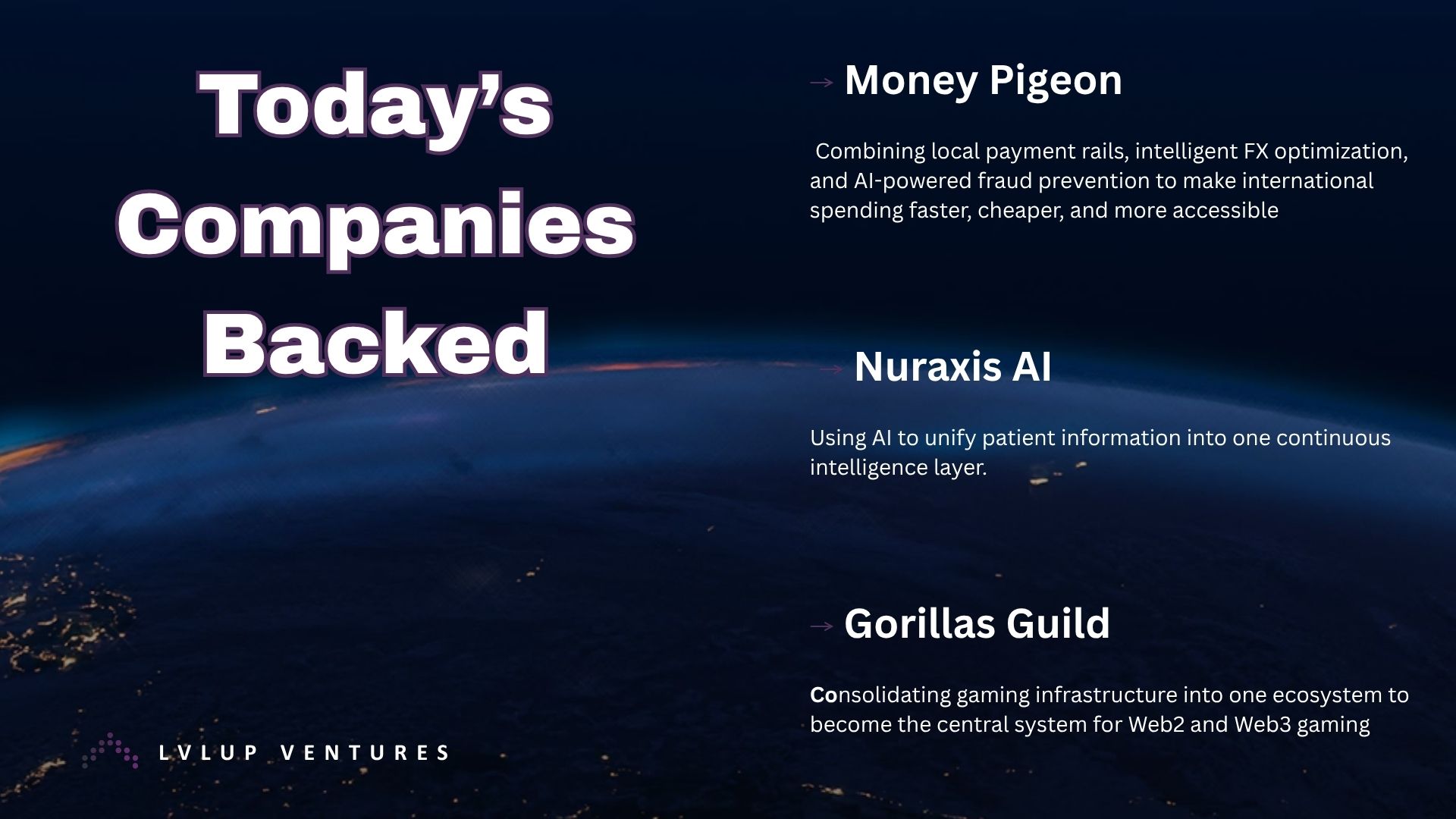
MoneyPigeon: Making Cross-Border Payments Feel Local
International travel has become easier than ever, but paying for everyday purchases abroad is still surprisingly complicated.
Travelers often juggle foreign transaction fees, unfavorable exchange rates, cash exchanges, and payment methods that don't always work across borders. The technology to move money exists, but the user experience remains fragmented.
MoneyPigeon is rethinking that experience by allowing users to pay directly in local currency through an AI-powered payment platform. Rather than forcing travelers to navigate multiple financial services, the platform simplifies cross-border spending into a seamless experience.
Instead of asking users to change their behavior, MoneyPigeon removes the complexity that has long been accepted as part of international travel.
Nuraxis AI: Turning Hospital Data Into Continuous Clinical Context
Healthcare has no shortage of information. In fact, hospitals generate enormous amounts of patient data every day.
The challenge is that much of this information exists across separate devices, monitoring systems, documentation platforms, and clinical workflows. While clinicians have access to more data than ever before, they often lack a complete picture of the patient's condition at any given moment.
Nuraxis AI addresses this challenge by creating a continuous view of patient context. By combining existing hospital data with bedside intelligence, the platform helps clinicians interpret fragmented information more effectively and provides real-time clinical support while keeping healthcare professionals in control of decision-making.
Rather than replacing existing hospital systems, Nuraxis AI enhances them by connecting information that was previously isolated.
Gorillas Guild: Creating a Unified Home for Gamers
Gaming has grown into one of the world's largest entertainment industries, but the player experience remains highly fragmented.
Gamers move between Discord, Twitch, Reddit, Steam, Epic Games, wallets, launchers, tournament platforms, and countless other applications just to participate in the communities they enjoy. Developers face similar challenges when trying to reach and retain the right audiences across multiple ecosystems.
Gorillas Guild is building what it describes as a gaming power app—a unified platform that combines player identity, game discovery, tournaments, community engagement, analytics, and Web3 infrastructure into one ecosystem.
Instead of requiring players to manage dozens of disconnected tools, the platform brings everything together under a single experience while giving game studios more effective ways to engage their communities.
The Common Thread
Although these companies operate in finance, healthcare, and gaming, they're solving remarkably similar problems.
Each founder recognized that their industry wasn't lacking technology—it was lacking connection.
When users constantly switch between platforms, manually piece together information, or repeat the same tasks across different systems, the problem often isn't capability. It's fragmentation.
The most impactful startups don't always introduce entirely new behaviors. Instead, they remove unnecessary complexity from existing ones.
That's exactly what these founders are doing.
Looking Ahead
As industries continue adopting AI, automation, and increasingly specialized software, fragmentation is likely to become an even bigger challenge.
The companies that create lasting value won't necessarily be those building the most features—they'll be the ones creating the simplest, most connected experiences.
Whether it's making payments abroad feel effortless, giving clinicians better patient context, or bringing the gaming ecosystem under one roof, these startups demonstrate an important lesson:
Sometimes the biggest innovation isn't building something new.
It's making everything that already exists finally work together.