We Backed Three Companies Rebuilding Critical Infrastructure Systems
A look at three companies transforming customer support, surgical navigation, and emergency care coordination through AI and modern operational infrastructure.
Some of the biggest startup opportunities aren’t flashy consumer trends.
They’re hidden inside systems that millions of people depend on every single day — systems still held together by fragmented workflows, manual coordination, and outdated tooling.
Customer support.
Surgical imaging.
Emergency hospital operations.
Most people accept the inefficiency because it has existed for so long.
Founders don’t.
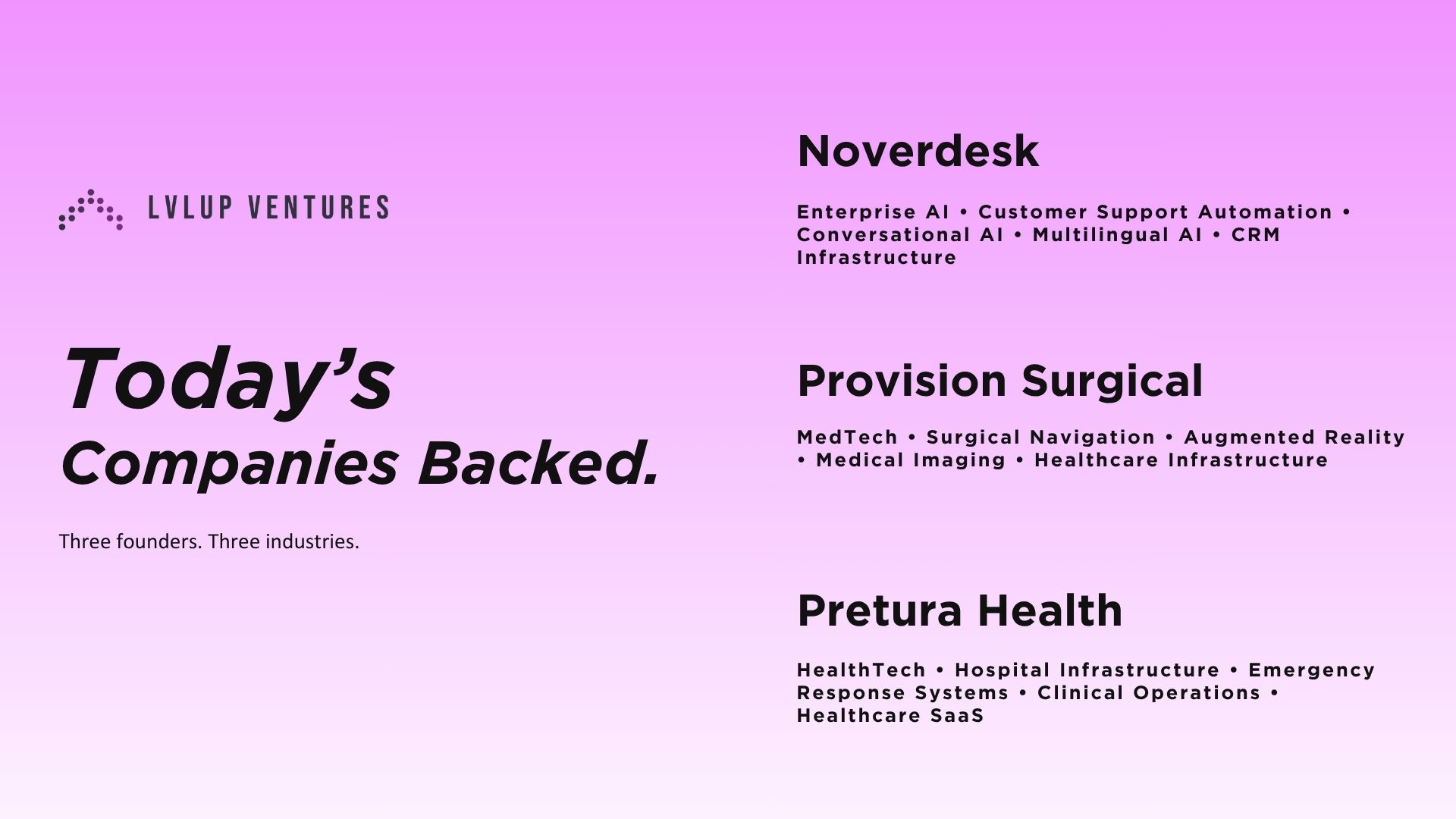
That’s why we’re excited to back Noverdesk, Provision Surgical, and Pretura Health — three companies rebuilding critical operational infrastructure across Africa, healthcare, and emergency medicine.
🤖 Noverdesk | AI Customer Support Infrastructure for Africa
Across Africa, businesses face a unique customer support challenge:
multiple languages, fragmented communication channels, and limited access to scalable support infrastructure.
Traditional call centers are expensive, inconsistent, and difficult for SMEs to scale. Meanwhile, many customers rely on messaging-first communication through WhatsApp, Instagram, Facebook, Telegram, and SMS rather than traditional support systems.
Noverdesk is building AI-powered customer service agents designed specifically for businesses operating across multilingual African markets.
The platform enables businesses to:
- deploy AI support agents instantly
- automate up to 80% of common support requests
- provide multilingual support across English and Swahili
- integrate directly with messaging platforms customers already use
- and manage support workflows through a centralized dashboard
What stood out to us was the early operational traction:
- 500+ customer conversations processed
- 5 live communication channels deployed
- active customer deployments already running
- warm lead conversion across automotive and vacation housing verticals
The broader market opportunity is massive:
Africa’s conversational AI and customer service automation market is projected to surpass $3B by 2030 as businesses increasingly digitize customer operations.
🩺 Provision Surgical | Giving Surgeons Real-Time 3D Vision
Modern surgery still relies heavily on mental reconstruction.
Surgeons often need to interpret flat 2D imaging and mentally translate it into precise 3D decisions during procedures — increasing complexity, fatigue, and the risk of implant misalignment.
Provision Surgical is building augmented reality surgical navigation infrastructure that transforms 2D medical imaging into real-time 3D visualization directly inside the operating room.
Its PAIR Guide system projects patient-specific anatomy and surgical plans directly into the surgeon’s field of view, creating what is effectively “X-ray vision” during procedures.
The technical performance metrics immediately stood out:
- ~99% distance accuracy with 0.75mm mean error
- ~99% angular accuracy with 0.71° mean error
- projected reduction of surgical procedures by up to 30 minutes
- fewer implant revisions and improved patient outcomes
The company has already:
- completed its MVP
- secured a licensing partnership with Vivo Surgery
- received FDA presub test approval
- filed multiple utility patents
- and is preparing for pilot testing with MedStar Health
What makes the opportunity compelling is not just the technology — it’s the economic advantage.
The platform is designed to deliver approximately $300K in annual savings per high-volume surgical center while avoiding the massive capital expenditure associated with surgical robotics.
🚑 Pretura Health | The Clinical Command Center for the Other 5,800 Hospitals
Emergency department boarding has become a national operational crisis.
Hospitals continue struggling with:
- fragmented staffing coordination
- delayed EMS communication
- overloaded emergency departments
- and expensive enterprise command center software priced out of reach for most hospitals.
Pretura Health is building the clinical command center infrastructure layer for the thousands of hospitals unable to afford traditional enterprise coordination systems.
Its EMS ER Bridge platform combines:
- EMS pre-notification
- dynamic staffing coordination
- acuity bed management
- and HEMS dispatch workflows
into one unified SaaS platform.
Unlike legacy enterprise builds that can take 18 months to deploy, Pretura’s platform is designed for implementation in just 2–6 weeks.
What stood out most was how much infrastructure is already operational:
- live production platform already deployed
- integrations across Epic FHIR R4, HL7, TeleTracking, and AWS
- 8 embedded triage engines
- active conversations across 22 hospitals in 4 regions
- pathway targeting $48M ARR by Year 5
The market dynamics are enormous:
over 5,800 hospitals remain priced out of traditional enterprise command center infrastructure despite emergency coordination becoming one of healthcare’s most urgent operational problems.
What These Companies Have in Common
Although these businesses operate in completely different industries, they share a common pattern:
They are rebuilding operational systems that people depend on every day — systems that have remained inefficient for far too long.
Whether it’s:
- multilingual customer support
- surgical navigation
- or emergency hospital coordination
the opportunity comes from replacing fragmented manual workflows with scalable infrastructure and automation.
The next generation of important companies will likely emerge not from inventing entirely new markets, but from rebuilding the systems society already relies on most.
We’re excited to support Noverdesk, Provision Surgical, and Pretura Health as they continue scaling toward their next milestones.