Why We Invested in Coverity: The Regulated Step Is the Wedge in Digital Transactions
E-signatures are now ordinary. Most people have signed a lease, an offer letter or a contract on a screen without thinking twice.
But in many of the transactions that matter most, such as real estate closings, loan documents, powers of attorney and certain legal filings, a signature alone is not enough. The document also has to be notarized, witnessed or handled under specific rules. That step is regulated, varies by state and, for a long time, required people to be physically in the same room.
What interested us about Coverity is that it builds around that regulated step rather than around the signature.
We invested in Coverity through the LvlUp First Check Fund.
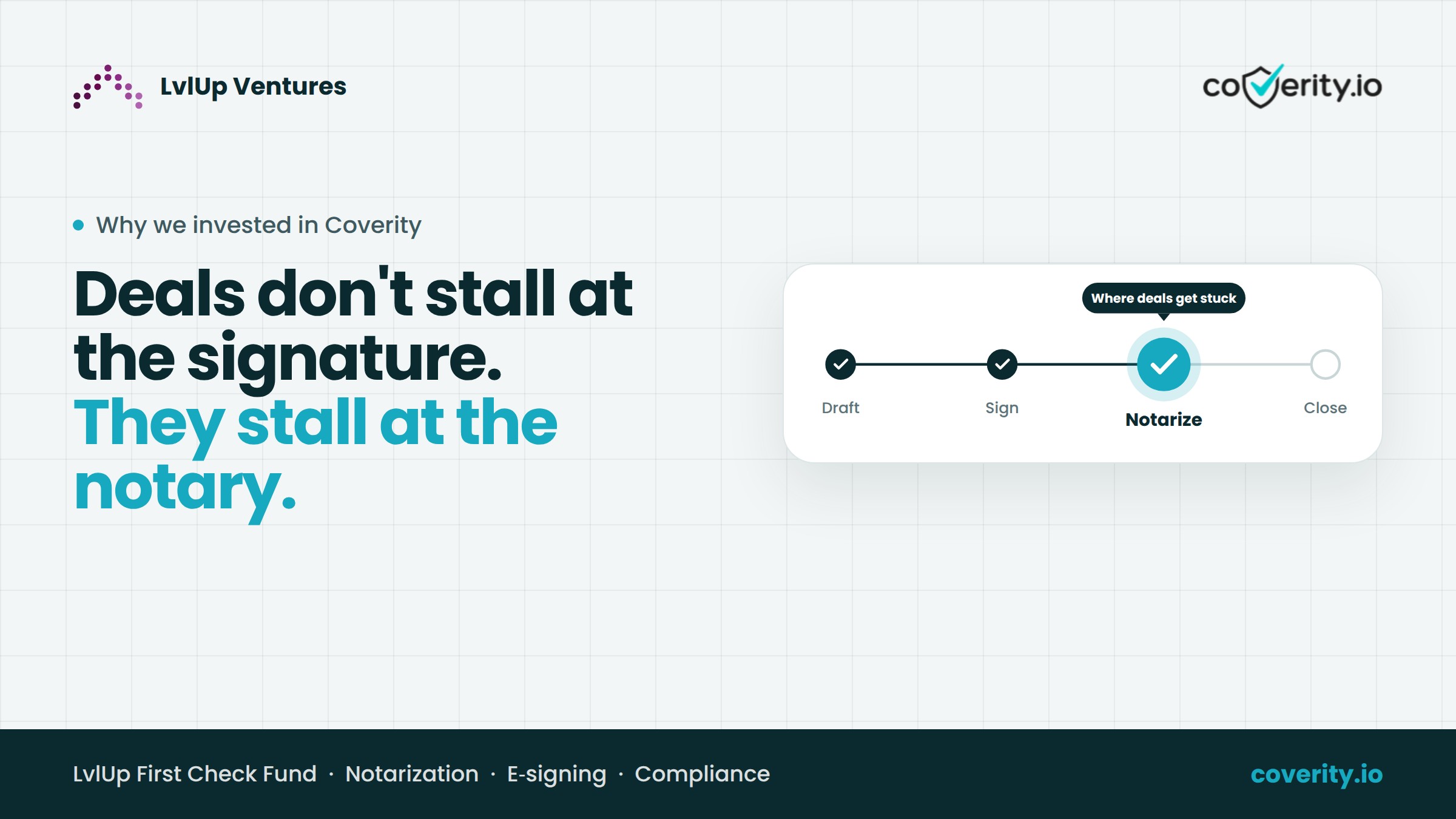
Why Notarization Is Where Digital Transactions Still Get Stuck
A typical real estate or lending transaction involves many parties: buyers, sellers, lenders, title and escrow companies, attorneys and notaries. Documents move between them through email, portals, printed packets and in-person appointments.
Most of that process can be digitized with standard tools. The notarization step is harder. It requires a commissioned notary, identity verification and compliance with rules that differ from state to state. Over the past several years, most states have authorized remote online notarization, which made it possible to complete this step digitally.
That legal change opened the door. But many of the businesses that depend on notarization still run the process across a patchwork of separate tools.
The distinction matters because the regulated step is where transactions stall. If it goes wrong, a closing is delayed or a document is invalid. Whoever makes that step reliable earns a central place in the workflow.
Owning the Regulated Step, Not Just the Signature
Coverity combines AI, workflow automation, e-signatures, notary services, customer portals and real-time collaboration in one platform. It serves notaries, title companies, escrow firms, real estate professionals, attorneys, lenders and other document-heavy businesses.
We think the combination is the point. General e-signature tools are excellent at getting a document signed. They are less focused on the rules, identity checks and record-keeping that notarized transactions require. Specialized notarization tools handle that step but often leave the rest of the workflow elsewhere.
A platform that owns the regulated step and the workflow around it becomes harder to replace. Once a title company runs its closings, documents and client communication through one system, switching means rebuilding the whole process, not swapping a signature tool.
Two Revenue Engines: Subscription Plus Transactions
Coverity makes money through monthly software subscriptions, plus transaction fees for notarizations and e-signing, and additional revenue from document storage, workflow automation and premium enterprise services.
From our perspective, that mix fits the market well. Subscriptions provide a stable base from businesses that use the platform every day. Transaction fees grow with volume, so revenue rises as customers do more deals on the platform.
It also creates a natural expansion path. A notary or a small title office can start with core tools, then add enterprise features, storage and automation as they grow.
Why Compliance Is a Feature Buyers Will Pay For
For many of Coverity's customers, the cost of a mistake is high. An improperly notarized document can delay a closing, create legal risk or require the whole process to be redone. Fraud in real estate transactions is also a growing concern.
That makes compliance and identity verification something buyers value, not a box to tick. We think a platform that makes the compliant path also the easiest path has a strong reason to be chosen.
Early Signal
Coverity was founded in 2025 by Christine Alifrangis and Andrea Salemi and reports $8,500 in monthly recurring revenue.
It remains early, and the team is small. What we find encouraging is that paying customers are already using the platform in a market where switching tools is not trivial.
What Has to Be True for This Model to Work
There is still plenty to prove.
State-by-state rules. Notarization law varies by state. Expanding across the country means keeping up with each state's requirements.
Competition. Established e-signature and online notarization providers are well funded. Coverity's edge has to come from owning the full workflow for specific customer types.
Transaction volume is cyclical. Real estate and lending activity rises and falls with interest rates and the housing market. The subscription base helps, but transaction revenue will move with the market.
Execution with a small team. Building compliance-heavy software and selling it takes people. How the company scales its team will matter.
What We Are Watching
We will be watching the mix between subscription and transaction revenue. The number of notarizations and signings processed each month. Retention among title, escrow and lending customers. Expansion into enterprise features. The number of states supported. And customer acquisition cost by segment.
If Coverity becomes the system where these transactions actually run, it earns revenue every time a deal closes.
Our View
We think the more important question in digital transactions is no longer whether documents can be signed online. They can. It is who owns the regulated steps that still slow transactions down.
Coverity is building around notarization and compliance, and around the workflow that surrounds them. That is why we invested through the LvlUp First Check Fund.
Welcome to the LvlUp portfolio, Coverity.