Why We Invested in Loadstone Labs: Building the Software Layer for Western Water Rights
Most people think of water as a utility. In the American West, it's also property.
Under the doctrine of prior appropriation, the legal system used across most Western states, a water right is a property right. It can be bought, sold, leased and changed to a new use. When there isn't enough water to go around, the oldest rights are served first. Priority dates going back to the 1800s still decide who gets water today.
What interested us about Loadstone is that this market has almost no software built for it.
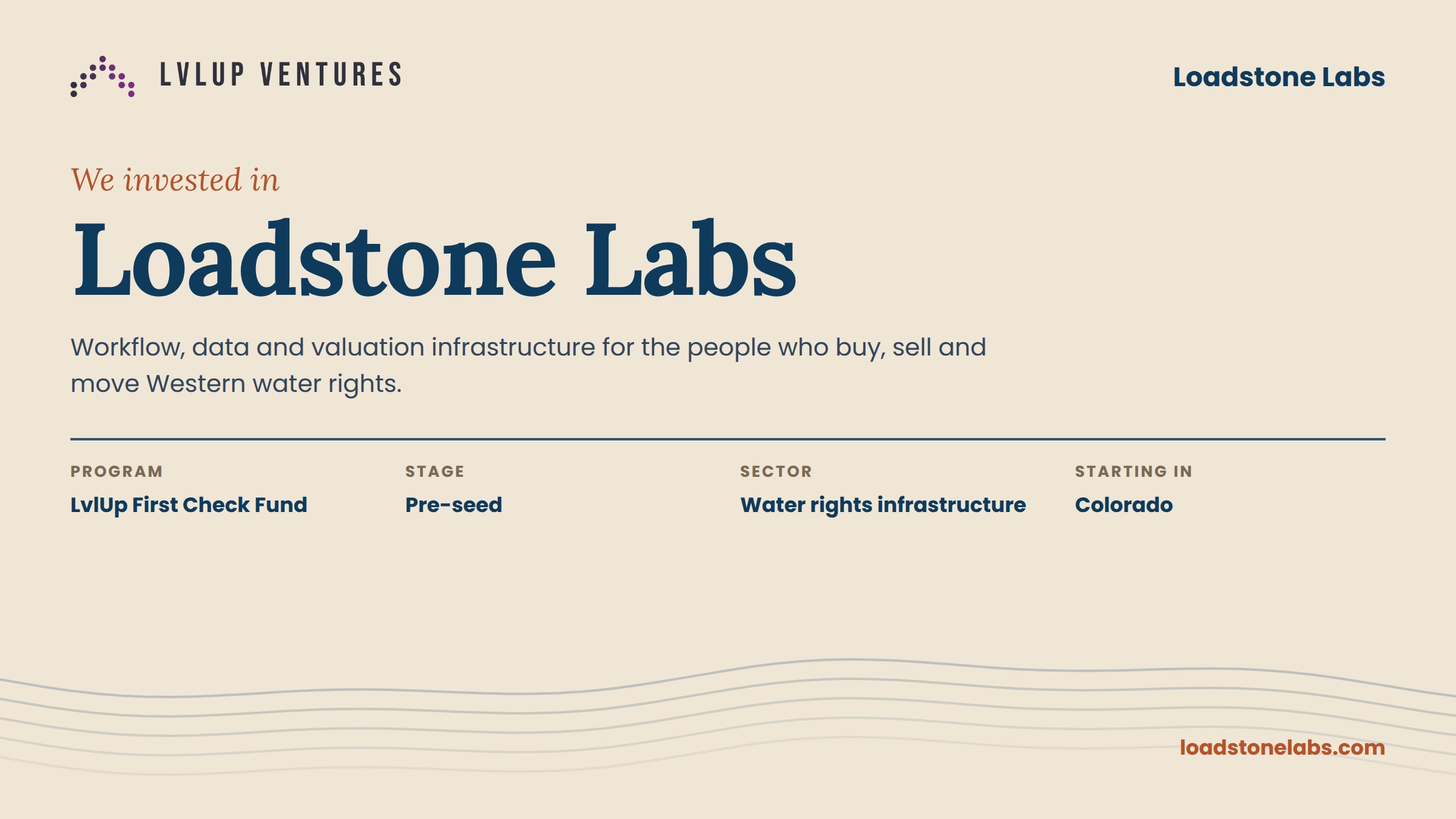
We invested in Loadstone through the LvlUp First Check Fund.
Why the Colorado River Is About to Force More Water to Change Hands
The Colorado River supplies water to tens of millions of people and a large share of the West's agriculture across seven states and Mexico. It has been over-allocated since the 1922 Colorado River Compact divided more water than the river reliably carries.
The guidelines that govern how Lake Powell and Lake Mead are operated were adopted in 2007 and expire at the end of 2026. The basin states and the federal government have been working through what replaces them, and the Bureau of Reclamation has been running an environmental review of post-2026 operations.
Whatever the outcome, the direction is clear. Less water to go around means more pressure to move it, through sales, leases, fallowing agreements and changes in use. Tribal water rights are also part of this picture, with tribes holding rights to a significant share of the river's flow.
Why Water Rights Have No Software Layer
Moving a water right is slow, specialized work.
A transfer typically requires title research through decades of decrees, reconstruction of how much water has historically been used, analysis to show other users won't be injured by the change, and approval from the state. In Colorado, change cases can take years.
Much of this is done manually by water attorneys and engineers, using public databases that are powerful but hard to navigate. Colorado's HydroBase is one of the most complete water rights databases in the country, but working with it efficiently takes expertise.
The distinction matters because the professionals doing this work are expensive and their time is the bottleneck. As demand for transfers grows, that bottleneck gets tighter.
What Loadstone Does
Loadstone is building the workflow, data and transaction infrastructure for the people who move water rights. It is starting in Colorado, working within the state's water community.
The first product is a co-pilot for water attorneys and professional engineers. It automates decree research in HydroBase, call alerts, decree extraction and augmentation plan accounting, and it's priced at $5,000 to $25,000 per seat per year.
Three Layers, Each Feeding the Next
What we found most interesting is how Loadstone's roadmap builds on itself.
Workflow. Seat licenses for the professionals already doing this work. This creates daily usage and a growing corpus of documents.
Transaction data. An automated database of water rights transactions, built from county recorder filings and licensed to investment funds and municipal water buyers as an API. Today, comparable sales are hard to find and harder to trust.
Valuation. An automated valuation model for water rights portfolios, licensed to funds and institutional buyers at $30,000 to $300,000 a year.
From our perspective, this is a familiar pattern from other property markets. Real estate went from paper records to transaction databases to automated valuation, and each step created a business. Water rights are earlier on that path, and the reallocation pressure in the West could speed it up.
What Has to Be True for This Model to Work
There is still plenty to prove.
Water law is local. Each Western state has its own system, records and procedures. Expansion means rebuilding knowledge state by state.
Professionals have to adopt it. Water attorneys and engineers are a small, expert community. The product has to be trusted by people who know the details better than anyone.
Transaction data takes time. A useful comparable-sales database depends on coverage and accuracy built over years.
Policy outcomes are uncertain. How the post-2026 Colorado River framework lands will shape how much water moves, and how fast.
What We Are Watching
We will be watching the first paying seats among Colorado water attorneys and engineers. Usage across decree research and augmentation accounting. Coverage of the transaction database. Early interest from funds and municipal buyers. And expansion into other Colorado River basin states.
Our View
We think the more important question in Western water isn't whether it's valuable. It's whether the market has the infrastructure to move it efficiently when it has to.
Loadstone is building that infrastructure, starting with the professionals who do the work today. It remains early, but that's why we invested through the LvlUp First Check Fund.
Welcome to the LvlUp portfolio, Loadstone Labs.
Sources to pull:
- Bureau of Reclamation: post-2026 Colorado River operations, and the 2007 Interim Guidelines.
- Bureau of Reclamation: Colorado River Basin Water Supply and Demand Study.
- Colorado Division of Water Resources: prior appropriation and HydroBase.
- Reuters or WSJ: coverage of the post-2026 negotiations.