Why We Invested in Navoy: Agentic AI and the Shift From Travel Search to Travel Execution
Travel is one of the largest consumer categories in the world, and one of the most digitized. Most people book flights and hotels online without thinking twice, and a small number of large platforms dominate online booking.
Those platforms were built around one thing: search. Give the traveler every option, let them compare, and take a commission when they book.
That model has served travelers well. But it leaves most of the work with the traveler. When we spent time with Navoy, the question we kept coming back to was simple. What changes when software can do that work instead?
We invested in Navoy through the LvlUp First Check Fund.
Why Travel Search Is Solved and Travel Execution Isn't
Finding a flight is easy. Planning a trip is not.
A real trip involves several decisions that depend on each other: dates, flights, where to stay, how to get between places, what to book in advance. Travelers stitch these together across tabs and apps. After booking, the complexity keeps coming. Flights are delayed or cancelled. Meetings move. A connection is missed. Each change can force a chain of other changes.
The distinction matters because this is where travelers spend the most time and feel the most frustration. It is also where the industry spends a lot on service. Search is well served by existing platforms. Execution and servicing are not.
What Agentic AI Changes in Travel
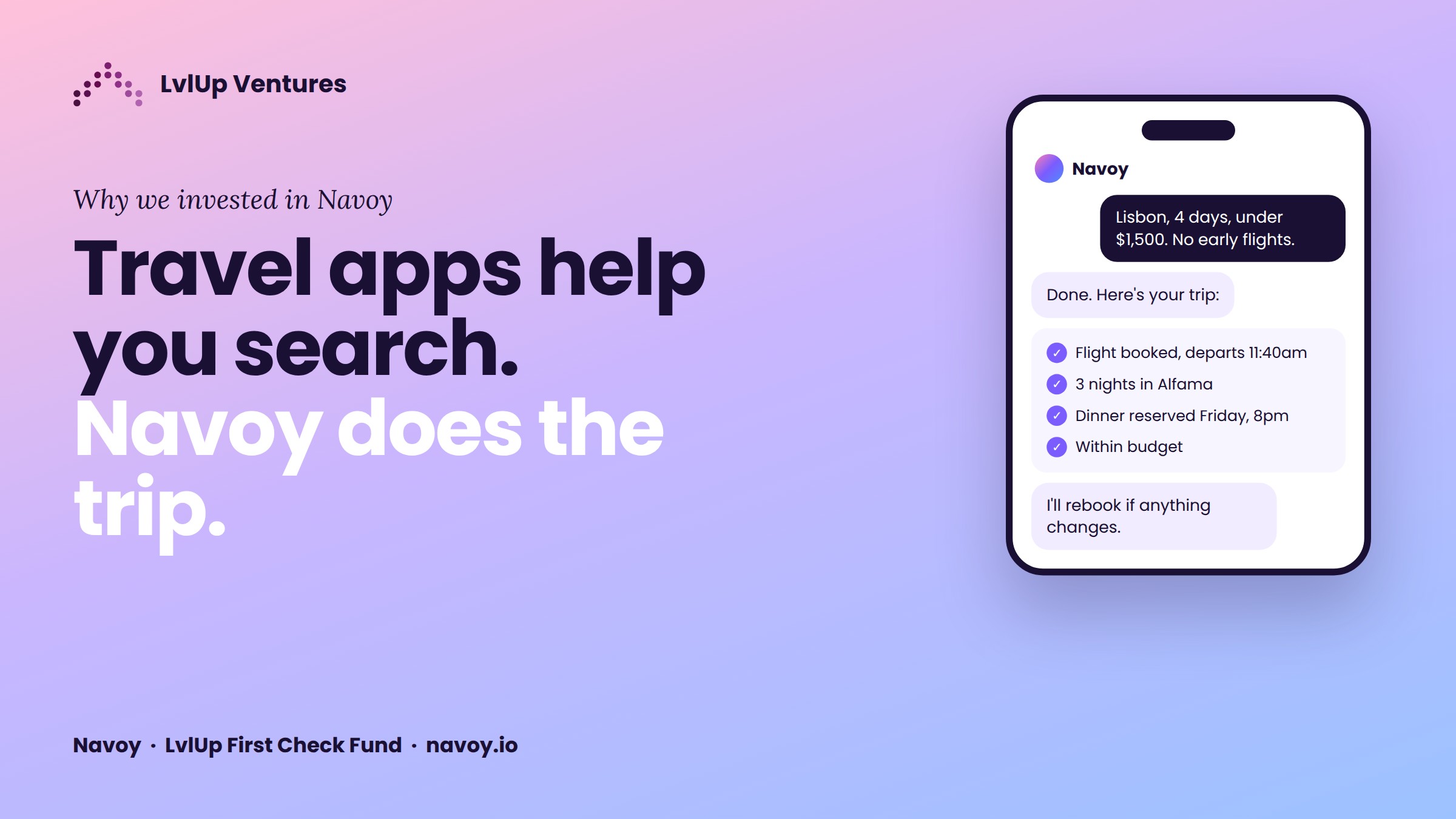
A new generation of AI systems can take actions, not just return results. In travel, that means an agent can plan a trip within a set of preferences and a budget, book the pieces, monitor the trip and respond when something changes.
We think travel is one of the clearest early categories for this shift. It is high-intent: people who start planning a trip usually intend to take it. It involves many steps and many suppliers, which is exactly the kind of coordination agents are suited to. And it is a category where people would happily hand off the work if they trusted the result.
From our perspective, the value moves from the moment of search to the whole life of the trip. The company that manages the trip end to end, and remembers what the traveler likes, has a stronger relationship than the one that showed them a list of flights.
What Navoy Does
Navoy is building an agentic commerce platform for travel. Its AI agent learns user preferences, then autonomously plans, books and manages trips, replacing a stack of fragmented travel apps with one system.
The goal is not a better search box. It is a travel agent that does the work, with the context of how each traveler likes to travel.
Three Revenue Streams, and Why the API Matters
Navoy makes money in three ways: commissions on travel bookings, premium AI subscriptions for travelers, and enterprise API partnerships that let businesses embed Navoy's agent into their own products or offer it under their own brand.
We think the third stream is worth paying attention to.
Consumer travel apps face a difficult distribution problem. Acquiring travelers directly is expensive, and the large platforms have enormous marketing budgets. An API changes that. Banks, card issuers, corporate travel tools, loyalty programs and other consumer apps all have reasons to offer travel to their users without building an agent themselves. If Navoy becomes the agent inside those products, it can reach travelers through partners rather than paying to win each one.
The model becomes particularly interesting when the two sides reinforce each other. Direct users help the agent learn. API partners bring volume. Both improve the product.
Early Signal
Navoy was founded in 2025 and reports $11,000 in monthly recurring revenue. For a company building in a category this competitive, early paying demand is a meaningful signal.
What Has to Be True for This Model to Work
There is still plenty to prove.
The agent has to be trusted with money. Booking on someone's behalf is a higher bar than making suggestions. Errors are costly and visible.
Supplier connections have to be deep. Acting across airlines, hotels and other providers requires reliable integrations, especially for changes and cancellations.
Incumbents are moving. Large travel platforms are building their own AI features. Navoy's edge has to come from focus, the quality of its agent, and distribution through partners.
Servicing is hard. The part of travel we think is most valuable, managing changes, is also the hardest to automate well.
What We Are Watching
We will be watching repeat booking rates and how often travelers return to Navoy for their next trip. How the agent performs when plans change mid-trip. The mix of commissions, subscriptions and API revenue. The first enterprise partners and the volume they bring. And customer acquisition cost across direct and partner channels.
Our View
We think the more important question in travel technology is no longer who has the best search. It is who can take a trip off the traveler's hands, from planning through the unexpected changes that always come.
Navoy is building for that, with a business model that doesn't depend only on winning travelers one at a time. It remains early, but that's why we invested through the LvlUp First Check Fund.
Welcome to the LvlUp portfolio, Navoy.