How Startup Valuations Actually Work at Pre-Seed and Seed (And Why Most Founders Get the Math Wrong)
Ask a founder what their valuation means, and you'll usually get some version of "how good my company is." That's the most common misunderstanding in early-stage fundraising, and it costs founders real equity.
There's No Formula at This Stage, and That's the Point
Later-stage valuation leans on revenue multiples, discounted cash flow, and comparable transactions. All of these methods need an actual financial history to work. At the pre-seed round, most companies don't have one. No meaningful revenue, sometimes no finished product, often nothing but a team and evidence that a real problem exists.
So the number attached to a pre-seed or seed round isn't a valuation in the traditional sense. It's closer to a placeholder both sides agree to: how much of the company a given check should buy, based on a shared prediction about what the company could become. Nobody in that negotiation actually believes the number is "true." And surprisingly, this is by design.
The Post-Money Confusion That Costs Founders Real Equity
Here's a concept that trips up founders constantly, and it's rarely explained clearly: the difference between pre-money and post-money valuation.
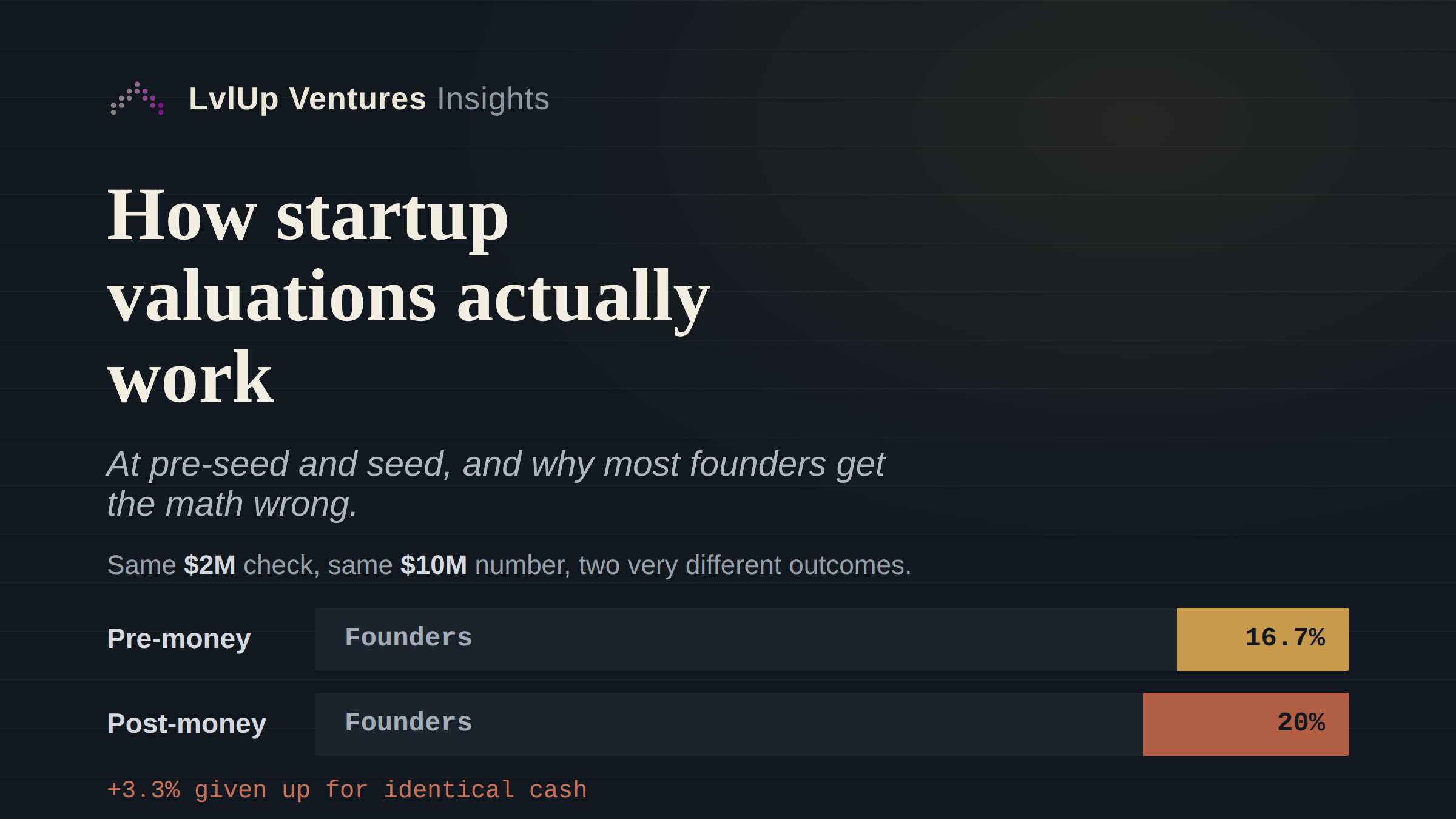
If an investor says "we're investing at a $10M valuation," ask immediately whether that's pre-money or post-money. It's not a technicality. A $2M check on a $10M pre-money valuation means the company is worth $12M after the round, and the investor owns 16.7%. The exact same $2M check on a $10M post-money valuation means the investor owns 20%, and the founder just gave up an extra 3.3% of their company for identical cash.
Most modern SAFEs default to post-money terms specifically because that standard made the math predictable for investors. But plenty of people still say "valuation" out loud without specifying which one they mean, sometimes because they haven't thought about the distinction themselves. Ask the question every time. It's one of the cheapest negotiations a founder will ever have.
The Hidden Dilution Problem in Stacking SAFEs
The part that almost no founder sees coming until it is too late is that raising multiple SAFEs at different valuation caps quietly creates dilution that doesn't fully show up until the priced round actually happens.
Each SAFE feels like its own separate, reasonable decision in the moment: a bit more capital, a slightly higher cap because the company's doing better. But all of those SAFEs convert at the same time, at their own individual caps, against the same fully diluted cap table, once a priced round finally triggers conversion. Founders who never modeled the stack together are often surprised by how much more dilution shows up at that moment than they expected from looking at each SAFE individually.
The fix isn't as complicated as it might seem. Model your fully diluted cap table every time you add a new SAFE to the stack, not just once, right before you raise a priced round. By then, the dilution is already locked in.
What Investors Are Actually Pricing, Beyond the Deck
Since there's no financial statement to anchor to, investors end up pricing things that are much harder to put a number on.
Market size and timing. A company solving a genuinely large problem at the right moment in that market's evolution supports a higher valuation than one solving a smaller problem, even with identical traction, because the eventual outcome, if it works, is bigger. Which is of course, the more appealing scenario for investors.
Specific founder-market fit. A founder with direct, lived experience in the exact problem they're solving consistently prices higher than an equally impressive founder without that context. It's one of the more reliable, and least discussed, drivers of early valuation.
Signal over scale. Ten users who all come back, refer others, and pay without being asked matter more than ten thousand who churn. Investors are looking for a pattern they can extrapolate from instead of sheer volume.
How much capital is being raised, against what specific milestone? A raise built around one clear, falsifiable milestone prices more cleanly than a vague "we need money to grow."
Why Chasing the Highest Number Is a Trap
A higher valuation isn't automatically the win it sounds like. It raises the bar for your next round, since the company now has to grow into that number and then clear an even higher one to raise again on good terms. Founders who take an inflated valuation early sometimes find themselves facing a down round later, having to raise at a lower price than their last round, which is a genuinely hard story to tell the market and a signal that makes new investors hesitate before they've even taken the first meeting.
The founders who fare best tend to be the ones who picked the valuation that let them clear their next milestone comfortably, not the one that made the current round feel best on paper.
The Real Takeaway
A pre-seed or seed valuation isn't a scorecard on how good your idea is. It's a negotiated number shaped by market size, founder-market fit, real signal, and how efficiently your ask is scoped, with pre-money/post-money math and SAFE stacking quietly determining how much of the company you actually keep. Founders who understand that stop optimizing for the highest number on the term sheet and start optimizing for the number that sets up a clean next round.
The real goal was not to win the negotiation, but to end up with a cap table that is still viable two rounds from now.