Why the First Check Matters More Than You Think
For many founders, the first institutional check is viewed as a financial milestone—a way to extend runway, hire talent, or accelerate product development.
While those outcomes are important, they're not what makes the first check so valuable.
The real value lies in what that investment represents.
When an institutional investor commits capital at the earliest stages, they're doing more than funding a company. They're validating a vision that often exists long before meaningful revenue, widespread customer adoption, or market recognition. They're making a decision based on conviction rather than certainty.
At this stage, there are very few guarantees. Markets evolve, products change, and business models adapt. What investors are ultimately backing is the founding team's ability to execute.
The First Check Creates More Than Capital
Early capital certainly helps a company move faster, but its impact extends well beyond the dollars invested.
For many founders, the first institutional investment creates momentum.
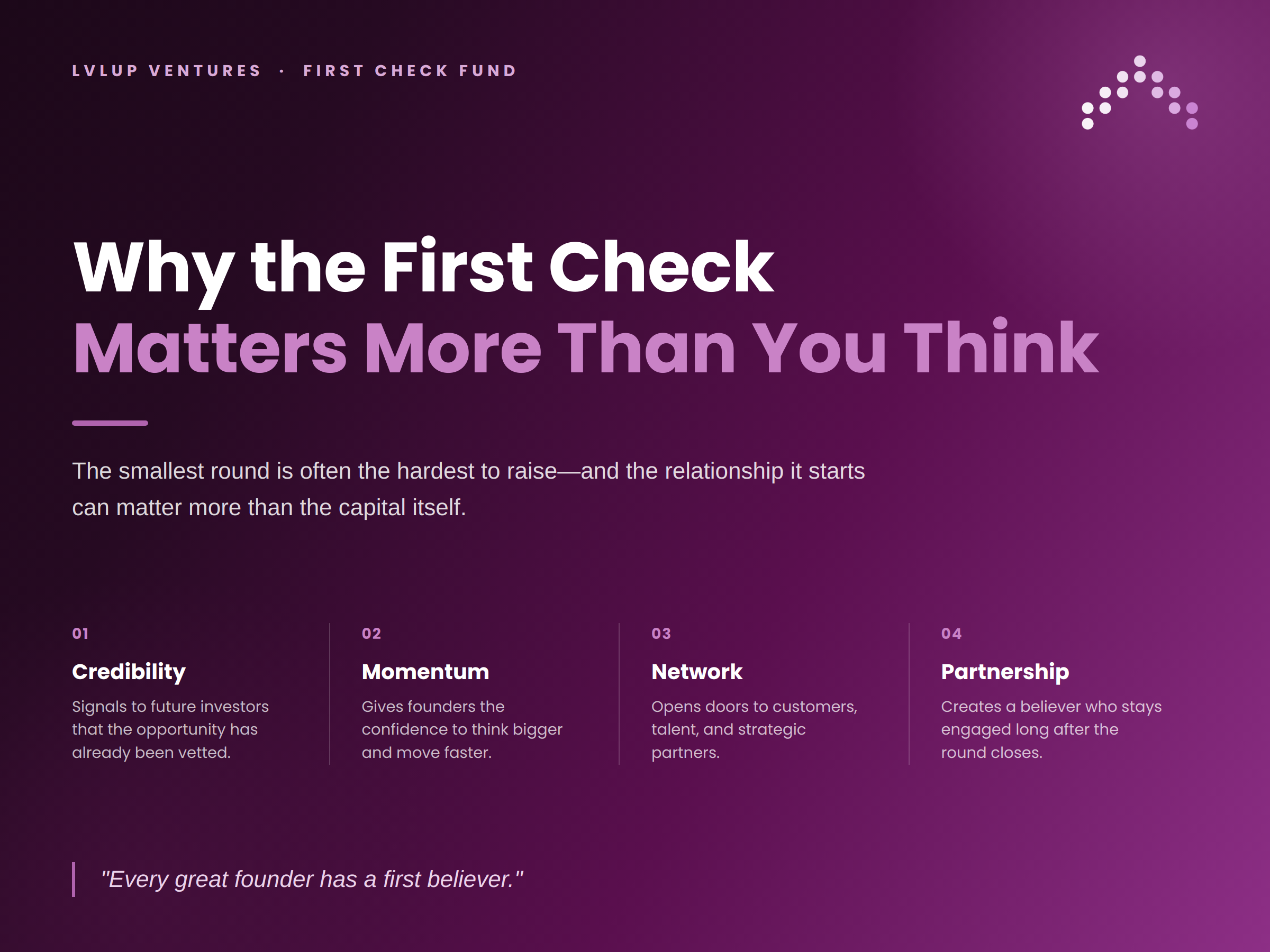
It provides credibility with future investors.
It makes recruiting easier because prospective employees recognize that experienced investors have already evaluated the opportunity.
It strengthens conversations with customers and strategic partners.
Most importantly, it gives founders the confidence to think bigger.
The first check often changes how the outside world perceives a startup—but it also changes how founders perceive what's possible.
Why It's the Hardest Capital to Raise
Ironically, the smallest rounds are often the most difficult.
Before product-market fit, before significant revenue, and before strong traction, investors have limited data to evaluate. There are few metrics that clearly indicate future success.
This forces early-stage investors to focus on different questions.
Does this team understand the problem they're solving?
Can they execute consistently?
Are they operating in a market large enough to support a venture-scale business?
Have they demonstrated the ability to learn and adapt quickly?
At the earliest stages, investing is less about predicting outcomes and more about identifying exceptional founders.
The Responsibility of Being the First Believer
Writing the first institutional check carries responsibility.
The first investor frequently becomes more than a source of capital. They become a long-term partner.
That partnership often includes making introductions to customers and future investors, helping recruit key talent, providing strategic guidance, and supporting founders through the inevitable challenges of building a company.
The relationship should create leverage—not just liquidity.
The best early-stage investors recognize that their greatest contribution often comes after the investment is made.
Why It Matters for Student Founders
Many of today's most successful companies began in universities, dorm rooms, or side projects.
Student founders often possess the curiosity, adaptability, and willingness to tackle ambitious problems. What they frequently lack is access.
Access to experienced operators.
Access to mentors.
Access to networks.
And access to institutional capital.
A first check at this stage can dramatically change a founder's trajectory. It enables them to spend less time proving they deserve an opportunity and more time building a company capable of earning one.
Looking Beyond the Numbers
Early-stage investing has never been about finding perfect businesses.
Perfect businesses rarely exist.
Instead, it's about identifying founders who have the vision, resilience, and discipline to build something meaningful over time.
Revenue matters.
Traction matters.
Market size matters.
But in the earliest days, belief matters too.
The first institutional check is not simply a financial transaction.
It's a signal of confidence, a catalyst for momentum, and often the beginning of a relationship that lasts far beyond the first round of funding.
Because every great company has a first customer.
Every great founder has a first believer.
And every venture-backed company starts with a first check.