Why We Backed Anbta: The Case for Trusted Re-Commerce in Baby Gear
Most consumer resale markets have a demand problem. People like the idea of buying secondhand, but the product has to be worth it, and the savings have to outweigh the hassle.
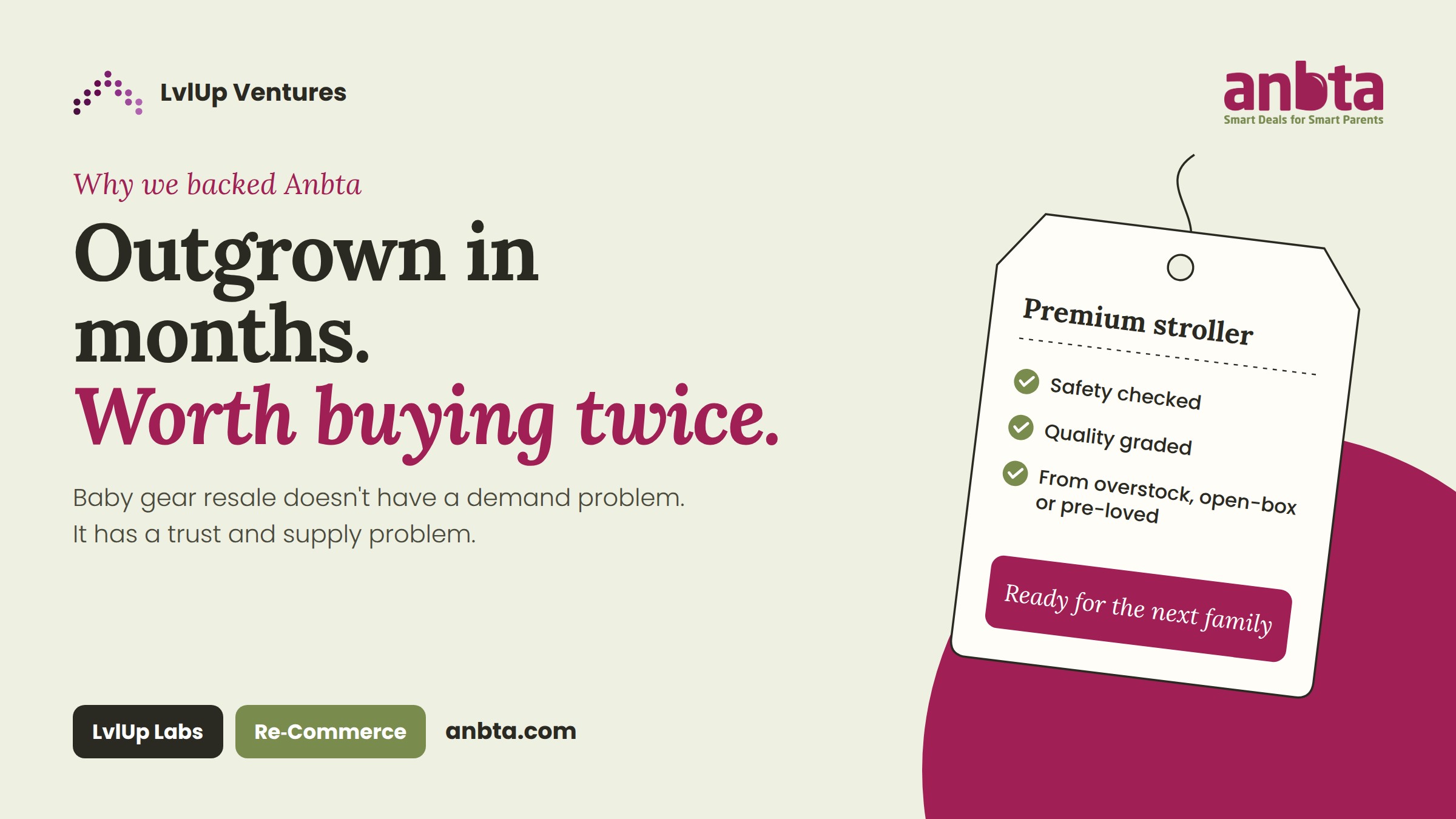
Baby gear is different. Parents buy some of the most expensive items they will ever buy for a household, a premium stroller, a travel system, a crib, and then their child outgrows them in months. The product is often in good condition. It still has real value. And there is always a new family that needs exactly the same thing.
What interested us about Anbta was not the size of that opportunity. It was a question about why this market, with obvious demand on both sides, still runs mostly through Facebook groups and online classifieds. We think the answer tells you a lot about who can win it.
We backed Anbta through LvlUp Labs.
Why Baby Gear Resale Has a Trust Problem, Not a Demand Problem
In most categories, a secondhand item that turns out to be worn or faulty is an annoyance. In baby gear, it can be a safety issue. A stroller with a damaged frame, a crib with missing parts, or a product that has been recalled is not something a parent wants to discover after the fact.
That changes the economics of resale. On an open classifieds site, the buyer carries all of the risk. They have to judge condition from photos, trust a stranger, and usually check recall status themselves, if they know to. Many parents who would happily save money decide it is not worth it.
The distinction matters because it means the valuable part of the transaction is not the listing. It is the confidence. A platform that inspects, verifies and stands behind what it sells is not competing with classifieds on convenience. It is making a purchase possible that many parents would otherwise skip.
Anbta was built around that idea. It checks the safety and quality of what it sells, which is exactly the step that is missing when a stroller changes hands through a social media group.
The Harder Problem in Resale Is Supply
Trust gets buyers in the door. Supply is what keeps a resale business alive.
Most peer-to-peer resale marketplaces struggle with the same thing: inventory is unpredictable. You depend on individual sellers deciding to list, and quality varies from one item to the next. That makes it hard to promise buyers anything, and hard to build a business with steady margins.
What we found most interesting about Anbta is how it approaches that problem. Rather than relying only on parents selling used items, Anbta pulls from three sources: pre-owned products, supplier defects, and retailer overstock and open-box stock.
The second and third sources matter more than they might seem. Retailers and suppliers regularly end up with products they cannot sell at full price, open boxes, last season's colorways, items with minor cosmetic defects. Anbta acquires that stock at liquidation prices and resells it through its own platform.
From our perspective, that turns a fragile marketplace into something closer to a retailer with a resale engine attached. The owned inventory gives Anbta more predictable supply and a margin it controls. The pre-owned marketplace adds breadth and earns commission and service fees without Anbta taking inventory risk.
A Two-Sided Model: Owned Inventory Plus Marketplace
Anbta makes money in two ways.
The first is resale. It buys premium overstock and open-box baby products from retailers and resells them. This is the larger and more controllable part of the business today.
The second is marketplace services. When families sell pre-owned items through Anbta, the company earns commission and service fees on the transaction.
We think the combination is the point. Owned inventory solves the cold-start and consistency problem that stalls most resale marketplaces. The marketplace side is capital-light and gets more valuable as more families join. Over time, the same inspection and trust layer serves both.
The model becomes particularly interesting when you think about the lifecycle of a family. The parent who buys a stroller from Anbta this year is likely to need a larger car seat, a high chair and a bed later, and may have a second child. They are also a natural seller once their child outgrows what they bought. If Anbta earns their trust on the first purchase, it has a reason to see them again on both sides of the market.
Why Retailers Could Become a Distribution Partner
There is a second-order effect in the supply strategy that we think is worth watching.
For retailers, overstock and returned open-box products are a cost. They take up space, tie up working capital, and often end up heavily discounted through channels the retailer does not control. A partner that reliably takes that stock, inspects it and sells it through a trusted channel is solving a real problem for them.
If Anbta can become the default outlet for that stock in its region, the relationship stops being purely transactional. It becomes a supply channel that competitors would find hard to replicate, because it depends on trust built with retailers over time.
Early Signal
It remains early, but the numbers so far are encouraging for a company founded in 2025.
Anbta generated about $36K in revenue in 2025. In 2026, it had reached roughly $96K year to date by mid-August, all direct to consumer. The company operates in Jordan today.
What we find more interesting than the absolute numbers is the mix. The business is already generating revenue from owned inventory, which suggests the supply side of the model is working before the marketplace side has fully scaled.
What Has to Be True for This Model to Work
There is still plenty to prove.
The inspection layer has to scale without eating the margin. Checking every item is the source of trust, but it is also a cost per unit. The model works if that cost stays small relative to the value of the goods.
Some categories need extra care. Certain baby products, car seats in particular, carry stricter safety expectations when sold secondhand, and some safety authorities advise against buying them used without a known history. Anbta will need clear category rules, and the discipline to leave some products out.
Supply partnerships need to hold. The owned-inventory side depends on steady access to retailer and supplier stock at the right price.
Regional expansion is not automatic. Moving beyond Jordan means new logistics, new retailer relationships and, in some markets, different product safety rules.
What We Are Watching
We will be watching a few things as Anbta grows. Sell-through rate and time to sell on owned inventory. Gross margin on owned inventory versus marketplace commission. The share of revenue coming from the marketplace side over time. Repeat purchase rates, and how often buyers later become sellers. The number and depth of retailer and supplier partnerships. And cost of inspection per item as volume grows.
If those move in the right direction, Anbta starts to look less like a resale site and more like the trusted channel for baby gear once it leaves the original box.
Our View
We think the more important question in baby gear resale is not whether parents want to save money. They clearly do. It is who they trust to sell them something that their child will use every day.
A classifieds site can't answer that. A platform that inspects every item, controls much of its own supply and stays with a family as their child grows can. That is the business Anbta is building, and it is why we backed them through LvlUp Labs.
Welcome to the LvlUp ecosystem, Anbta.