Introduction
Reaching product-market fit is a milestone worth celebrating—but it’s also where many B2B SaaS companies quietly stall.
Before PMF, metrics exist to validate an idea. After PMF, metrics exist to guide execution. Yet many founders continue tracking the same early-stage indicators long after they’ve outlived their usefulness. The result? Misallocated capital, mistimed hires, and growth that feels harder than it should. Startup pitch communicates vision, traction, and growth potential clearly.
Post-PMF B2B SaaS companies don’t fail because they lack ambition. They fail because they scale without the right instrumentation.
This is a breakdown of the metrics that actually matter once PMF is achieved—and how elite SaaS teams use them to compound advantage.
Why Metrics Change After Product-Market Fit
Before PMF, metrics answer one core question: Does anyone want this?
After PMF, the question becomes:
Where should we invest next to grow efficiently and sustainably?
At this stage:
- Growth is no longer theoretical
- Revenue is repeatable
- Customers behave in patterns
Metrics stop being diagnostic and start becoming directional.
Tracking the wrong ones creates false confidence. Tracking the right ones creates leverage.
The Metrics That Matter Most After PMF
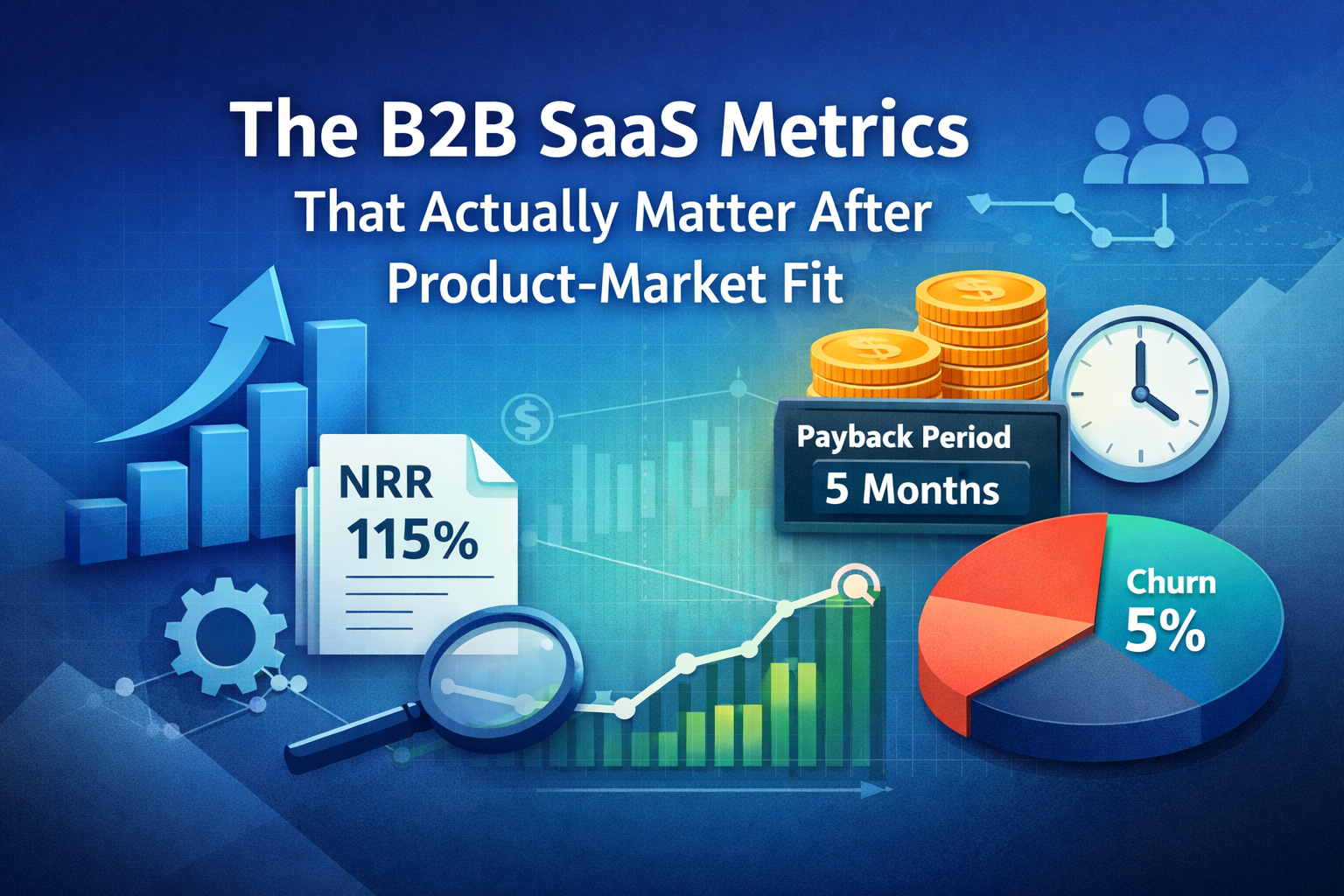
1. Net Revenue Retention (NRR)
NRR is one of the clearest indicators of SaaS quality.
It answers a critical question:
Does this product grow inside existing customers without constant replacement?
High-performing B2B SaaS companies often see:
- 110–120%+ NRR in strong expansion models
- Expansion revenue outpacing new logo acquisition
Why it matters:
- Expansion revenue is cheaper than acquisition
- It compounds predictably
- It reduces pressure on sales efficiency
NRR doesn’t just reflect customer happiness—it dictates how aggressively you can scale.
2. Payback Period
Revenue growth without payback clarity is fragile growth.
Payback period measures how long it takes to recover the cost of acquiring a customer. Post-PMF, this metric becomes foundational because it determines how fast capital can be recycled.
Why elite teams obsess over it:
- Shorter payback = faster reinvestment
- Faster reinvestment = compounding growth
- Compounding growth = optionality
A SaaS company with moderate growth and strong payback often outperforms one with explosive growth and weak capital efficiency.
3. Gross Margin by Revenue Cohort
Not all ARR is created equal.
Post-PMF teams break down gross margin by:
- Customer segment
- Acquisition channel
- Contract type
This reveals:
- Which revenue is scalable
- Which revenue quietly drags margins
- Where pricing or packaging needs refinement
Ignoring margin quality leads to growth that looks good on dashboards but weakens the business underneath.
4. Churn: Logo vs Revenue
Churn should never be viewed as a single number.
Logo churn answers: How many customers leave?
Revenue churn answers: How much value leaves?
The distinction matters because:
- Losing small customers may not hurt
- Losing the wrong customers always does
Post-PMF companies focus on churn quality, not just churn quantity.
Turning Metrics Into Execution
Metrics only matter if they inform action.
High-performing SaaS teams use metrics to decide:
- Where to hire
- Where to spend capital
- Which growth levers to pull next
For example:
- Strong NRR + weak acquisition → invest in GTM
- Strong acquisition + weak payback → fix funnel efficiency
- Strong revenue + weak margins → refine pricing or delivery
Metrics become operating instructions, not reporting artifacts.
Common Post-PMF Mistakes
Many SaaS companies stall not because growth is impossible—but because decisions are mistimed.
Common errors include:
- Scaling sales before fixing retention
- Increasing marketing spend without payback clarity
- Hiring ahead of systems
- Raising capital without a deployment plan
The fastest-growing companies aren’t reckless—they’re precise.
How We Think About Metrics at LvlUp
At LvlUp, we evaluate SaaS businesses the same way experienced operators do: through durable metrics, not narratives.
That’s why our Seed Fund and the B2B SaaS Accel Fund is designed specifically for post-PMF companies with:
- Real revenue
- Predictable unit economics
- Clear growth levers
When metrics tell a clear story, capital should accelerate execution—not introduce new risk.
Conclusion
Product-market fit is not the finish line. It’s the starting point for disciplined growth.
The B2B SaaS companies that win long-term aren’t the loudest or fastest—they’re the ones that measure what matters, invest intentionally, and compound advantage over time.