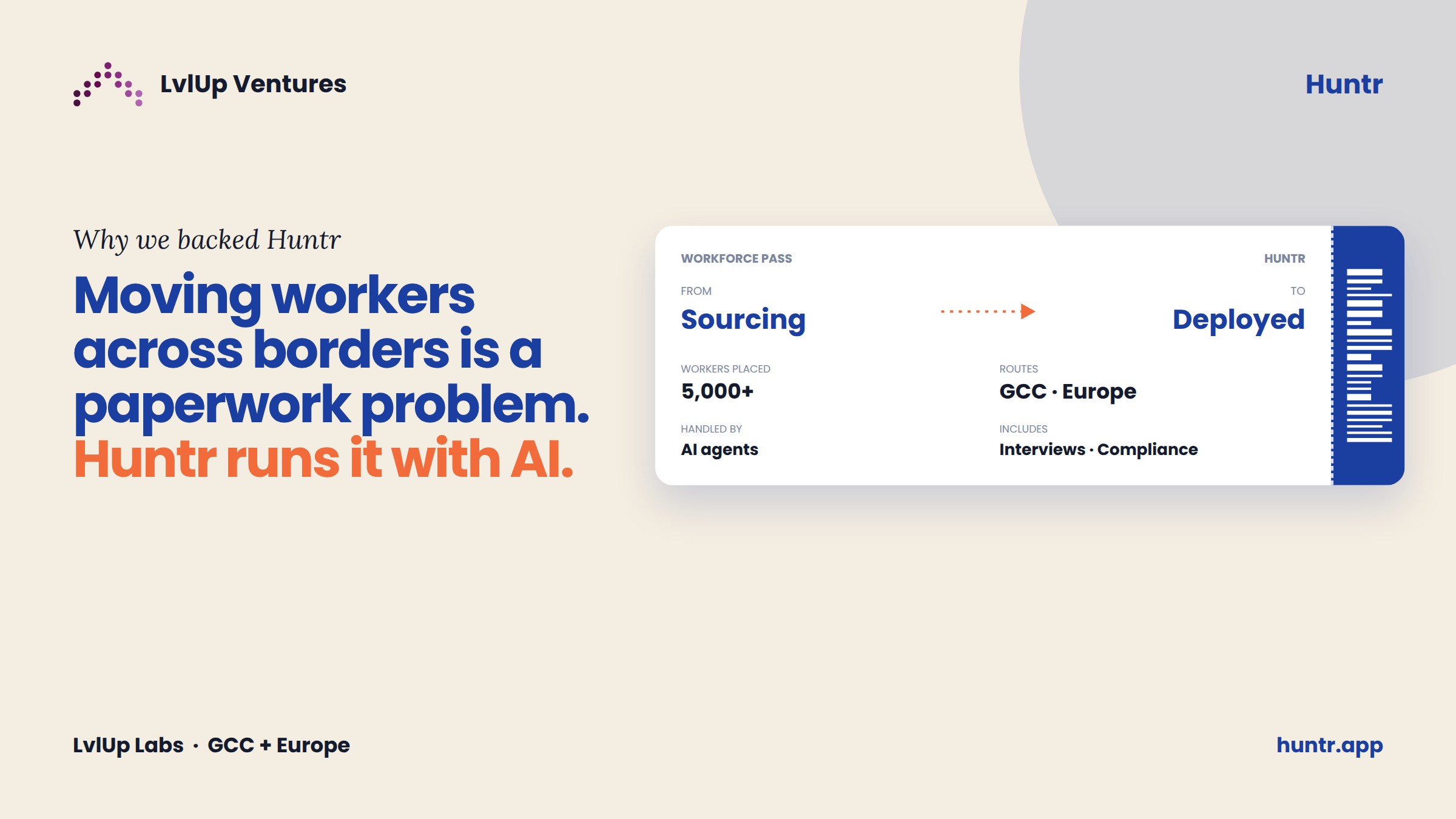
Why We Backed Huntr: AI Infrastructure for Cross-Border Blue-Collar Hiring
Some of the world's fastest-growing economies are built by workers who were hired from somewhere else. Across the Gulf, foreign workers make up a large share of the workforce in construction, hospitality, logistics and services. In Europe, employers in construction, transport and care report persistent shortages in skilled trades.
The demand for workers is not the interesting part of this market. It is well documented. What interested us about Huntr is the part in between: how a worker actually gets from one country to a job in another.
We backed Huntr through LvlUp Labs.
Why Cross-Border Hiring Breaks in the Middle
For a single blue-collar placement across borders, a lot has to happen. A recruiter has to source the worker. Someone has to interview them and check their skills. The employer needs documents verified, medical checks done, a contract issued and a work visa approved. Then there is travel and deployment.
Each step often involves a different party. Local recruiters, agencies, employers, government portals and travel providers all hold part of the process. Coordination tends to happen over messaging apps and spreadsheets. When something goes wrong, the delay is expensive for the employer and even more so for the worker waiting to start.
The distinction matters because this is where the cost and the risk sit. Not in finding demand, and not in finding workers, but in running the process between them reliably and compliantly.
Why Compliance Is Becoming the Center of the Market
There is a second shift that makes this more interesting now.
Pressure on how workers are recruited is rising. International bodies have pushed for fair recruitment practices, including the principle that workers should not pay recruitment fees. Large employers and their customers increasingly want visibility into their supply chains, including how labor is sourced. Governments continue to update rules on work permits and worker protection.
From our perspective, that turns compliance from a back-office task into a buying criterion. An employer who can show that its workers were recruited transparently and documented properly is in a stronger position than one who can't. A platform that makes the compliant path the easiest path has a real advantage.
What Huntr Does
Huntr is building an AI operating system for blue-collar labor mobility. Its AI agents automate sourcing, interviewing, compliance and deployment across the GCC and Europe.
What made Huntr stand out to us is that this is already happening at meaningful scale. The company has placed more than 5,000 workers and generated $500,000 in revenue profitably in 2025. For a company at this stage, profitability is an unusual and useful signal. It suggests the unit economics of each placement already work.
From Placement Fees to Recurring Software
Huntr makes money in two ways. It earns a success-based placement fee of roughly $500 per worker placed. It also sells a recurring software subscription, around $10,000 per enterprise per year, for workforce, compliance and mobility management.
We think the combination is the core of the investment case.
Placement revenue is transactional. It depends on hiring volume, which rises and falls with construction cycles and project pipelines. Software revenue is recurring and tied to the ongoing work of managing a foreign workforce: renewals, compliance records, transfers and redeployments.
The model becomes particularly interesting when the two feed each other. Placements bring employers onto the platform. Once their workforce data lives there, the software becomes the system they run it on. Over time, a recruiting business starts to look more like infrastructure.
Why the GCC Is the Right Starting Point
Huntr is based in the MENA region and operates across the GCC and Europe. The GCC has one of the highest concentrations of cross-border blue-collar hiring in the world, with large, ongoing construction and infrastructure programs. That gives Huntr dense, repeated demand in its home market, and a strong base from which to expand into European corridors where shortages are growing.
What Has to Be True for This Model to Work
There is still plenty to prove.
Every corridor is different. Visa rules, recruitment regulations and documentation requirements vary by sending and receiving country. Expansion means building local knowledge, not just adding a language.
Trust has to hold on both sides. Workers need confidence that the process is fair and transparent. Employers need confidence that workers arrive on time and fully compliant.
The software has to stand on its own. The long-term value depends on employers paying for the platform between placements, not only when they hire.
Hiring is cyclical. Placement volume will move with construction and infrastructure spending in each market.
What We Are Watching
We will be watching the share of revenue that comes from recurring software. The number of employers who adopt the platform after their first placement. Time from sourcing to deployment. Margin per placement as automation increases. And performance in new country corridors.
If Huntr can show that employers stay on the platform after the hire, the thesis becomes much stronger.
Our View
We think the more important question in global blue-collar hiring isn't where the workers are or where the jobs are. It is who can make moving between them simple, fast and compliant.
Huntr is building that layer, and it's already doing it profitably at real scale. That's why we backed them through LvlUp Labs.
Welcome to the LvlUp ecosystem, Huntr.