Why We Invested in Lithex: Pricing Litigation Risk in U.S. Infrastructure Permitting
There is broad agreement in the U.S. that it takes too long to build things. Mines, transmission lines, pipelines and energy projects can spend years in environmental review before a shovel goes in the ground. Much of the policy conversation focuses on speeding up that review.
When we spent time with Lithex, we came away thinking the more important question sits one step later. What happens after a permit is issued?
For large projects, approval is often not the end of the process. It is the beginning of the legal challenge. We invested in Lithex through the LvlUp First Check Fund because we think the company is building around that part of the problem, and because the data it collects could become valuable well beyond the permitting team.
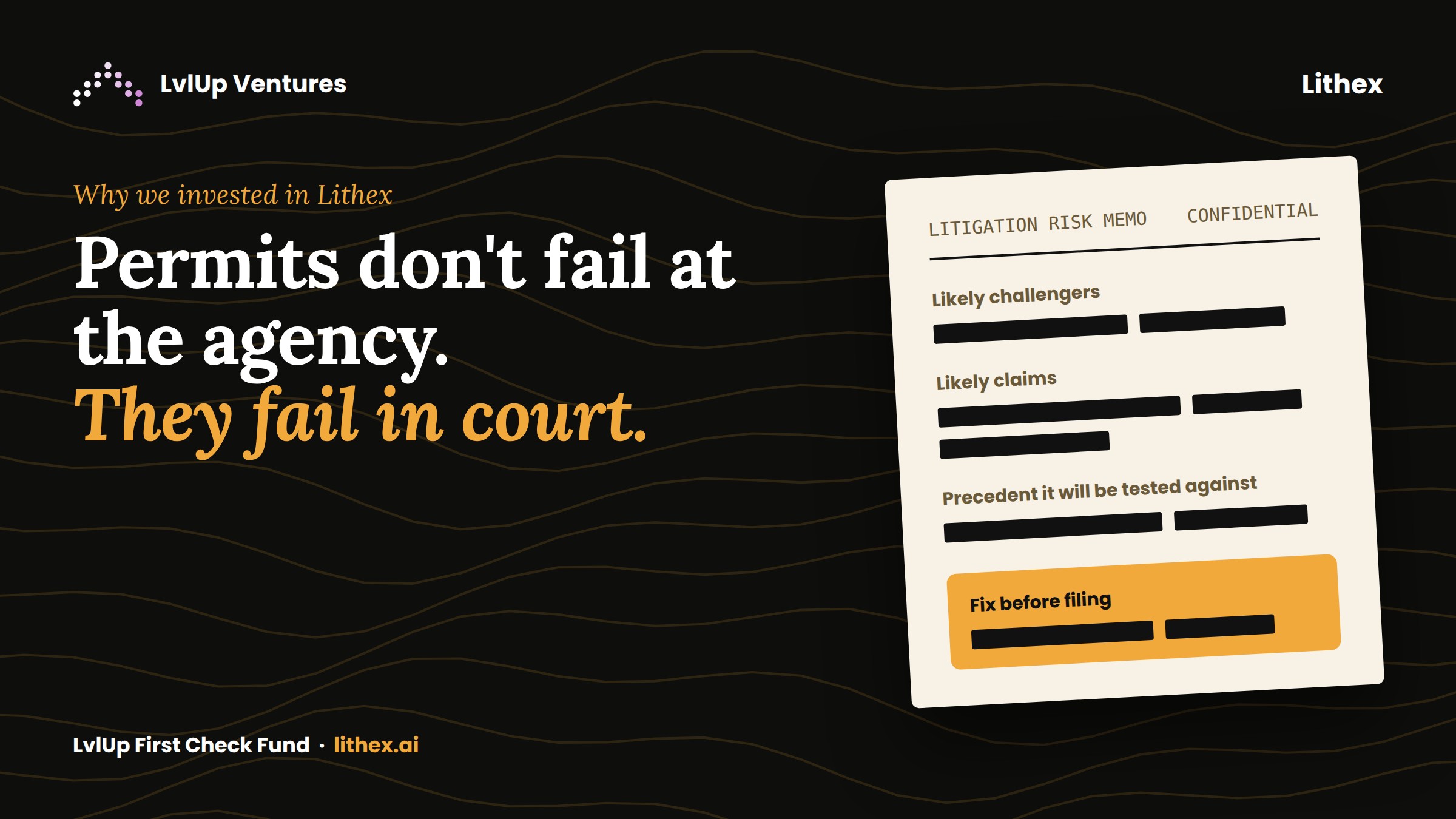
Why Infrastructure Permits Fail in Court, Not at the Agency
Major federal infrastructure projects generally go through environmental review. Once a permit is granted, opponents can challenge the adequacy of that review in court. If a judge agrees, the permit can be vacated or the project enjoined, sometimes years after it was approved.
The distinction matters because of timing. By the time a lawsuit lands, the operator has usually spent heavily on studies, engineering, land and legal work. A challenge at that stage doesn't just delay a project. It puts capital that has already been deployed at risk.
Recent legal and legislative changes have shifted the ground. Congress amended NEPA in 2023 with new page and time limits for reviews, and the Supreme Court's 2025 decision in Seven County Infrastructure Coalition v. Eagle County narrowed how far agencies must look in their analysis. Changes like these don't end litigation. They change which arguments work, which means the history of how cases have been decided matters more, not less.
The Budget Lithex Replaces Already Exists
What made Lithex interesting to us as an investment is that it doesn't need to create a new budget line.
Operators already pay specialist firms to predict how a project will be challenged. According to the company, that work costs somewhere between $150,000 and $1 million per project, and much of it is done by hand, based on the cases a senior partner happens to remember.
Lithex does that work systematically. It reads a project's record against the full history of environmental litigation and produces a memo showing how the project is likely to be sued, who is likely to sue, and what to fix before filing. It sells this as a one-time onboarding fee plus a tiered annual subscription that re-scores the record as new case law comes in.
From our perspective, that's a strong starting point. The buyer, usually the VP of Permitting or Head of Environmental Affairs, already spends this money, already feels the risk personally, and can compare the output against what they get today.
Why Hardrock Mining Is the Right Beachhead
Lithex is starting with hardrock mining. We think that choice makes sense.
Mining projects are long, capital-intensive and closely scrutinized, and the U.S. push to build domestic supply chains for critical minerals has put more of them on the table. Those projects need permits, and they tend to attract challenges. A tool that reduces the chance of a successful challenge has obvious value in that setting.
Mining also gives Lithex a focused dataset to start from before expanding into transmission, pipelines and other infrastructure, where the same underlying problem exists.
The More Valuable Product May Be the Risk Signal
The part of the thesis we find most interesting is not the memo itself.
Every time Lithex predicts how a project will be challenged, the prediction can eventually be checked against what actually happens in court. Over time, that builds a record of which risks mattered and which didn't. The company's longer-term plan is to turn that outcomes data into a priced risk signal for the capital markets that finance infrastructure: project-finance lenders, infrastructure private equity, royalty and streaming companies, and insurers.
The model becomes particularly interesting when you think about how those buyers work today. They underwrite permitting and litigation risk, but mostly through judgment and outside counsel. A consistent, data-backed view of that risk would be useful to them, and it's something a permitting team's software vendor is unusually well placed to build.
What Has to Be True for This Model to Work
There is still plenty to prove.
The predictions have to be good. Operators will judge Lithex on whether its memos catch the challenges that actually matter. Accuracy will be tested in public, in court.
Legal buyers move carefully. Permitting teams work closely with outside counsel. Lithex has to fit into that relationship rather than compete with it.
The law keeps changing. New statutes and court decisions shift the landscape. That creates demand for a tool that keeps up, but it also means the model is never finished.
The data business takes time. A risk signal for lenders and insurers depends on a track record. That is a multi-year build.
What We Are Watching
We will be watching the first customer deployments in mining. How Lithex's predictions compare with actual challenges over time. Renewal rates on the annual subscription. Expansion into other types of infrastructure. And early conversations with lenders or insurers about the risk signal.
Our View
We think the more important question in U.S. infrastructure isn't only how fast a permit can be issued. It's how well it holds up once it has been.
Lithex is building around that question, with a product that replaces an existing budget and a dataset that could matter to the people who finance these projects. It remains early, but that combination is why we invested through the LvlUp First Check Fund.
Welcome to the LvlUp portfolio, Lithex.