Why We Backed PLMBR: AI Agents and the Contractor Back Office
Contractors and service trades are one of the largest and most fragmented parts of the economy. Plumbers, electricians, HVAC firms, remodelers and specialty contractors number in the hundreds of thousands in the U.S. alone, and most are small businesses.
Software companies have chased this market for a long time. The results have been mixed. Plenty of tools exist, and plenty of contractors still run their business on paper, spreadsheets, texts and memory.
When we spent time with PLMBR, we came away thinking the reason was less about the software itself and more about what it asked of the customer. We backed PLMBR through LvlUp Labs because we think AI agents change that equation.
Why Contractor Software Has Struggled to Stick
Running a contracting business involves a lot more than the work on site. Someone has to write proposals and estimates, follow up with prospects, schedule crews, coordinate jobs, send invoices, chase payments and track whether each job actually made money.
Most contractor software organizes that work. It gives the business a place to track proposals, a calendar for scheduling and a system for invoicing. That's useful, but it doesn't remove the work. Someone still has to do each task. For a small business with no dedicated office staff, the software often becomes one more thing to keep updated, and it gets abandoned.
The distinction matters because the real constraint for most small contractors isn't organization. It's capacity. There aren't enough hours in the day, and the owner is usually the one doing the admin at night.
Why Labor, Not Software, Is the Real Competitor
The construction and trades industries face persistent labor shortages. That shortage shows up on job sites, but it also shows up in the office. Small contractors struggle to hire and keep estimators, office managers and coordinators.
From our perspective, that reframes the opportunity. If AI can do the office work itself, the product isn't competing with other contractor apps. It's competing with the salary of the person the contractor would otherwise hire, or with the owner's own evenings and weekends.
That's a much larger budget, and a much clearer reason to buy.
What PLMBR Does
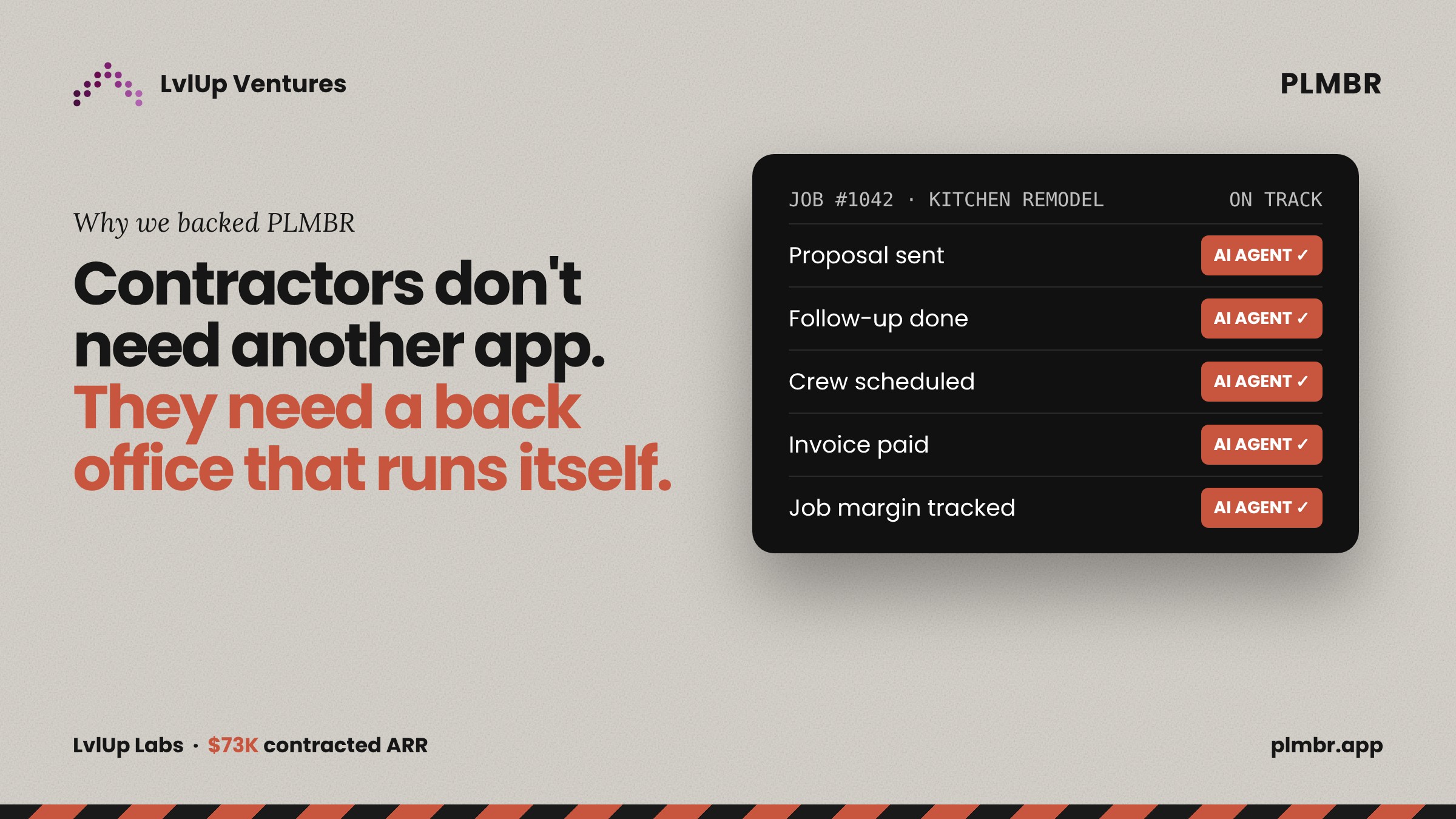
PLMBR gives contractors AI agents that run sales and operations. The agents handle proposals, customer communication and follow-up, scheduling, project coordination, invoicing and job finances.
The shift is from software the contractor uses to software that does the work. The contractor stays in control of decisions, but no longer has to carry every step of the process personally.
Pricing Against Labor, Not Against Apps
PLMBR sells annual contracts to project-based and service contractors. Customers currently pay between $10,500 and $25,000 a year, depending on which agents and workflows they use, with additional charges for extra AI seats and usage beyond what's included.
We think that pricing is the clearest sign the thesis is working. A contractor would not pay that much for a scheduling app. They would pay it for help that replaces part of a hire. The contracts are annual, which gives PLMBR predictable revenue and gives customers a reason to get fully set up.
The usage component also matters. As contractors rely on the agents for more of their work, revenue can grow with them.
Early Signal
Four months after launch, PLMBR has five paying customers representing $73,000 in contracted annual recurring revenue. For a company this early, in a market known for being hard to sell to, that's an encouraging start.
What we find most meaningful isn't the total. It's that each customer is paying a meaningful amount per year, which suggests the product is being bought as a replacement for real work.
What Has to Be True for This Model to Work
There is still plenty to prove.
The agents have to be reliable. A missed follow-up or a wrong invoice has real costs. Contractors will judge PLMBR on consistency.
Onboarding has to be fast. Small businesses have limited patience for setup. The faster a contractor sees results, the more likely they stay.
Retention has to hold. Annual contracts are only valuable if customers renew. The first renewal cycle will tell us a lot.
Distribution is still hard. Contractors are fragmented and busy. Reaching them efficiently, through trade associations, suppliers or referrals, will matter as much as the product.
What We Are Watching
We will be watching renewal rates on annual contracts. Time from signing to first value. Expansion revenue as customers add agents and usage. How many hours of admin work the agents take on per customer. And customer acquisition cost by channel.
If customers renew and expand, PLMBR starts to look less like a software vendor and more like the back office for small contractors.
Our View
We think the more important question in trades software isn't which app has the most features. It's which product actually takes work off the contractor's plate.
PLMBR is building for that, and pricing against the labor it replaces. It remains early, but the first customers are paying real money for real work. That's why we backed them through LvlUp Labs.
Welcome to the LvlUp ecosystem, PLMBR.