Why We Invested in Tesphase: Home Solar Became a Timing Problem
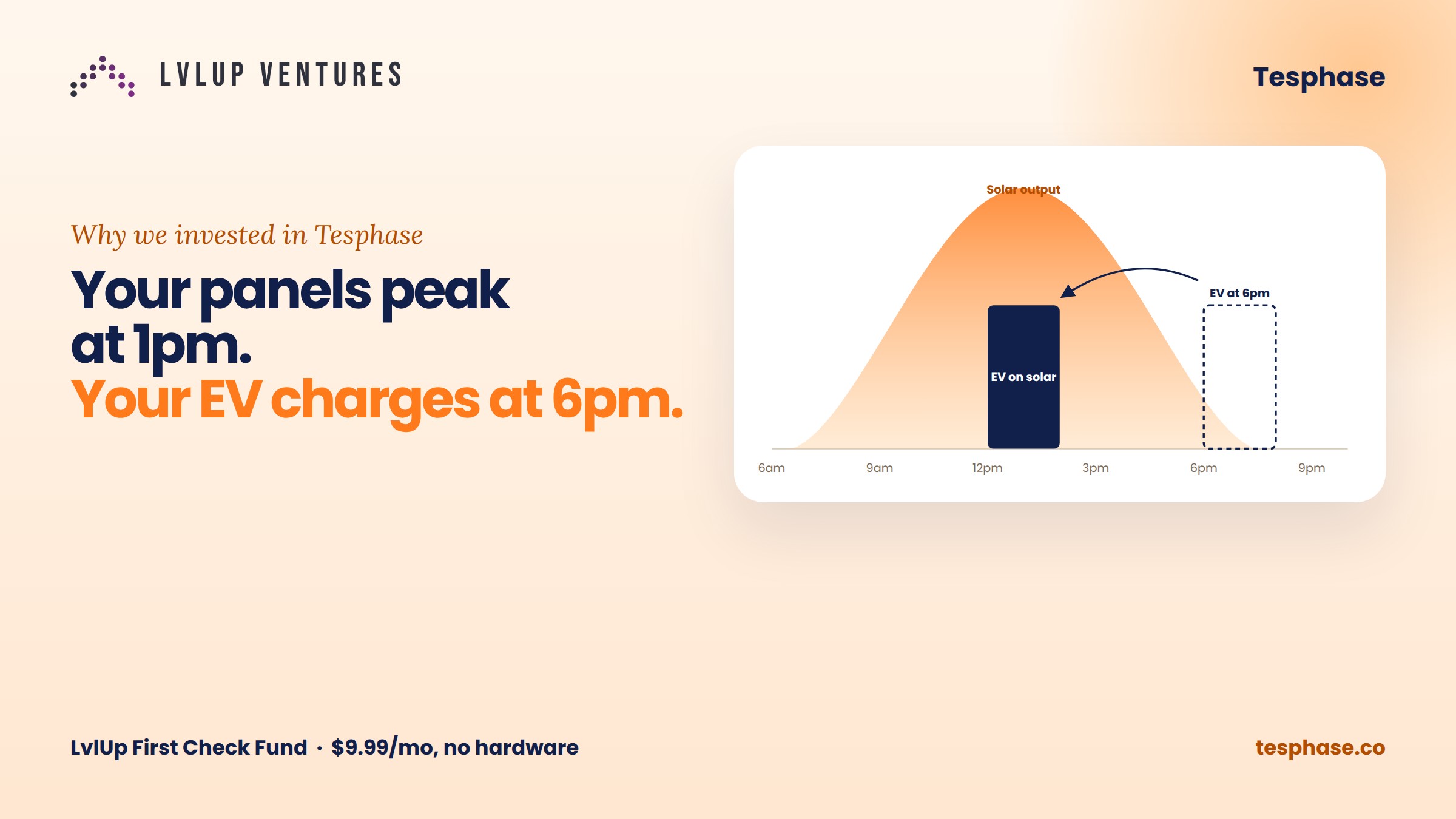
Your solar panels peak at 1pm. Your EV charges at 6pm.
In California, that gap now costs homeowners real money every day.
We think the fix is software, not a $20K battery. Enter Tesphase.
For most of the past decade, home solar in California was a simple pitch. Install panels, send extra power back to the grid, and get credited close to what you pay for electricity. The math worked almost regardless of when you used energy.
That changed in 2023. Under the state's new net billing rules, known as NEM 3.0, the credit for solar sent back to the grid dropped sharply. Exported solar now earns roughly a quarter of the retail rate.
What interested us about Tesphase is what that change did to the problem. Home solar stopped being mainly a question of how much you generate. It became a question of when you use it.
We invested in Tesphase through the LvlUp First Check Fund.
Why NEM 3.0 Turned Solar Into a Timing Problem
Solar panels produce the most power in the middle of the day. Households tend to use the most in the late afternoon and evening, when people come home, the AC is running and the EV plugs in.
Under the old rules, that mismatch didn't matter much, because exported power was credited at close to the retail price. Under the new rules, it matters a lot. A homeowner can export solar cheaply at 1pm and then buy power back at a much higher price at 6pm.
The distinction matters because it changes what creates value. More panels don't solve it. Using the solar you already make, at the time you make it, does.
The Battery Was the Default Answer
The standard solution has been a home battery. Store the midday solar, use it in the evening.
Batteries work, but they're expensive, typically $15,000 to $25,000 installed, and they require an installer, a site visit and a meaningful upfront decision. For many homeowners who already own panels, that's a hard second purchase to justify.
From our perspective, that left room for a different answer. Many households already own devices that can shift when they use energy: an EV that doesn't need to charge at a specific time, a smart thermostat that can pre-cool the house. These are, in effect, batteries the homeowner already paid for.
What Tesphase Does
Tesphase is a vendor-neutral orchestration engine for home energy. It connects to the homeowner's existing solar system, EV and smart thermostat, then automatically shifts flexible loads into solar hours, routing excess generation into the EV and the home instead of exporting it at the lower rate.
It requires no hardware and no installer, and setup takes about five minutes from a phone. The consumer subscription is $9.99 a month.
The company is live across the U.S. and its system has already sent thousands of charging commands and made tens of thousands of automated decisions.
Why the Bigger Opportunity Is the Network
The consumer subscription is the entry point. We think the more interesting business comes later.
The first expansion is installers. Solar installers currently upsell batteries as a way to make NEM 3.0 economics work. Tesphase can give them a software-only option, which could become a per-customer or revenue-share channel.
The second is the grid. Once thousands of homes have flexible, coordinated loads, that capacity can be dispatched during periods of high demand. Utilities and grid operators already pay for this kind of flexibility through virtual power plant programs. A software company that has built the installed base and the cross-vendor data is well placed to offer it.
The model becomes particularly interesting because each layer reinforces the others. Every home added makes the network more useful to utilities, and every utility program adds value for homeowners.
What Has to Be True for This Model to Work
There is still plenty to prove.
Savings have to be real and visible. Homeowners will stay if they can see the money they're keeping each month.
Integrations have to be reliable. Tesphase depends on connecting to many brands of solar systems, EVs and thermostats. Staying vendor-neutral means maintaining all of those connections.
Utility programs take time. Virtual power plant revenue depends on utility partnerships and program rules that vary by region.
Rates keep changing. Tariff structures evolve, which creates demand for smart orchestration but also means the product has to keep adapting.
What We Are Watching
We will be watching monthly retention and measured savings per home. Growth in connected devices. The first installer partnerships. Early conversations with utilities about virtual power plant programs. And expansion beyond California into other markets with similar rate structures.
Our View
We think the more important question in home energy is no longer only how much solar a household can generate. It's how well it uses what it already makes.
Tesphase answers that with software, using hardware homeowners already own, and builds toward a network the grid will pay for. It remains early, but that's why we invested through the LvlUp First Check Fund.
Welcome to the LvlUp portfolio, Tesphase.
Sources to pull:
- CPUC: the Net Billing Tariff decision (NEM 3.0).
- DOE: Pathways to Commercial Liftoff, Virtual Power Plants.
- Lawrence Berkeley National Laboratory: home battery cost data (Tracking the Sun).