Non-Dilutive Financing: The Capital Strategy Most Founders Overlook Until It's Too Late
Every founder knows the equity fundraising playbook. Deck, pitch, term sheet, dilution. It is the default mental model for how startups get capital — and for a significant number of companies at a significant number of stages, it is the wrong tool for the job.
Non-dilutive financing does not take equity. It does not require a board seat, a valuation negotiation, or a preferred liquidation preference stacked on top of your cap table. It provides capital that founders keep full ownership through — and in the right circumstances, it is not just a viable alternative to equity, it is a strategically superior one.
The founders who understand this early build fundamentally different companies than the ones who do not. They grow faster per dollar of equity given up, they retain more control through inflection points, and they arrive at later-stage raises with far cleaner cap tables and far more leverage in the negotiation.
Why Most Founders Miss It
The bias toward equity financing is structural, not rational. Accelerators, angel networks, and VC firms are the loudest voices in the early-stage ecosystem — and they all have equity-based business models. The infrastructure around non-dilutive capital is quieter, more fragmented, and requires more founder-side effort to navigate.
The result is that most founders encounter non-dilutive options late, often when they are already in the middle of an equity round, or when they have hit a growth ceiling that more equity capital alone cannot fix. At that point, the non-dilutive option becomes a patch rather than a strategy.
Used proactively — before the equity raise, alongside it, or instead of it — non-dilutive financing changes the trajectory of a company in ways that compound significantly over time.
The Main Categories Worth Understanding
Revenue-based financing. Capital is repaid as a percentage of monthly revenue until a fixed repayment cap is reached — typically 1.2x to 1.5x the original amount. No equity given up, no fixed repayment schedule. This works best for companies with predictable recurring revenue, strong gross margins, and a clear use of funds tied to revenue-generating activities. It is particularly well suited for B2B SaaS and subscription businesses that have found product-market fit and need fuel for growth.
Venture debt. Debt financing from specialized lenders, typically structured alongside or shortly after an equity round. It extends runway without additional dilution and is often used to bridge between rounds or to fund capital expenditures that equity is inefficient for. It typically comes with warrants — a small equity component — but the dilution is a fraction of what an equivalent equity raise would cost.
Grants and government programs. Genuinely non-dilutive capital that requires no repayment and no equity. The SBIR and STTR programs in the US, Innovate UK, and equivalent programs globally provide substantial capital to companies working on technology with commercial and social relevance. These programs are underutilized by startups because the application process is demanding — but for companies that qualify, the capital is among the cheapest available anywhere.
Strategic partnerships and customer-funded development. Enterprise customers will sometimes pay in advance for the development of features or integrations they need — particularly when the company is solving a critical problem and the customer has more capital than the startup does. This is non-dilutive, signals strong product-market fit, and produces a long-term customer relationship alongside the capital.
Royalty-based financing. More common in CPG, hardware, and consumer businesses. A lender provides capital in exchange for a percentage of future revenues or gross profit over a defined period. Like revenue-based financing, it preserves equity while providing growth capital.
When Non-Dilutive Capital Makes the Most Sense
Not every company is a fit for every non-dilutive instrument. The decision requires honest assessment of stage, revenue profile, and what the capital is actually for.
Non-dilutive financing tends to be the right tool when the use of capital is tied directly to revenue generation — inventory, marketing spend, sales headcount, or customer acquisition — and the returns from that deployment are predictable enough to model a repayment curve. It is also the right tool when a founder is approaching an equity round with strong metrics and wants to avoid a dilutive bridge, or when a company is between rounds and needs runway extension without reopening the cap table.
It is less well suited for deep technology development with long time horizons, pre-revenue companies without the revenue metrics to underwrite against, or situations where what the company needs is not just capital but the network, expertise, and signal of a specific equity investor.
The most sophisticated founders use non-dilutive and dilutive capital together — equity for the long-horizon bets and relationship capital, non-dilutive for the operational fuel that generates near-term returns.
The Cap Table Math That Changes Everything
The compounding effect of preserving equity early is one of the most underappreciated dynamics in early-stage company building.
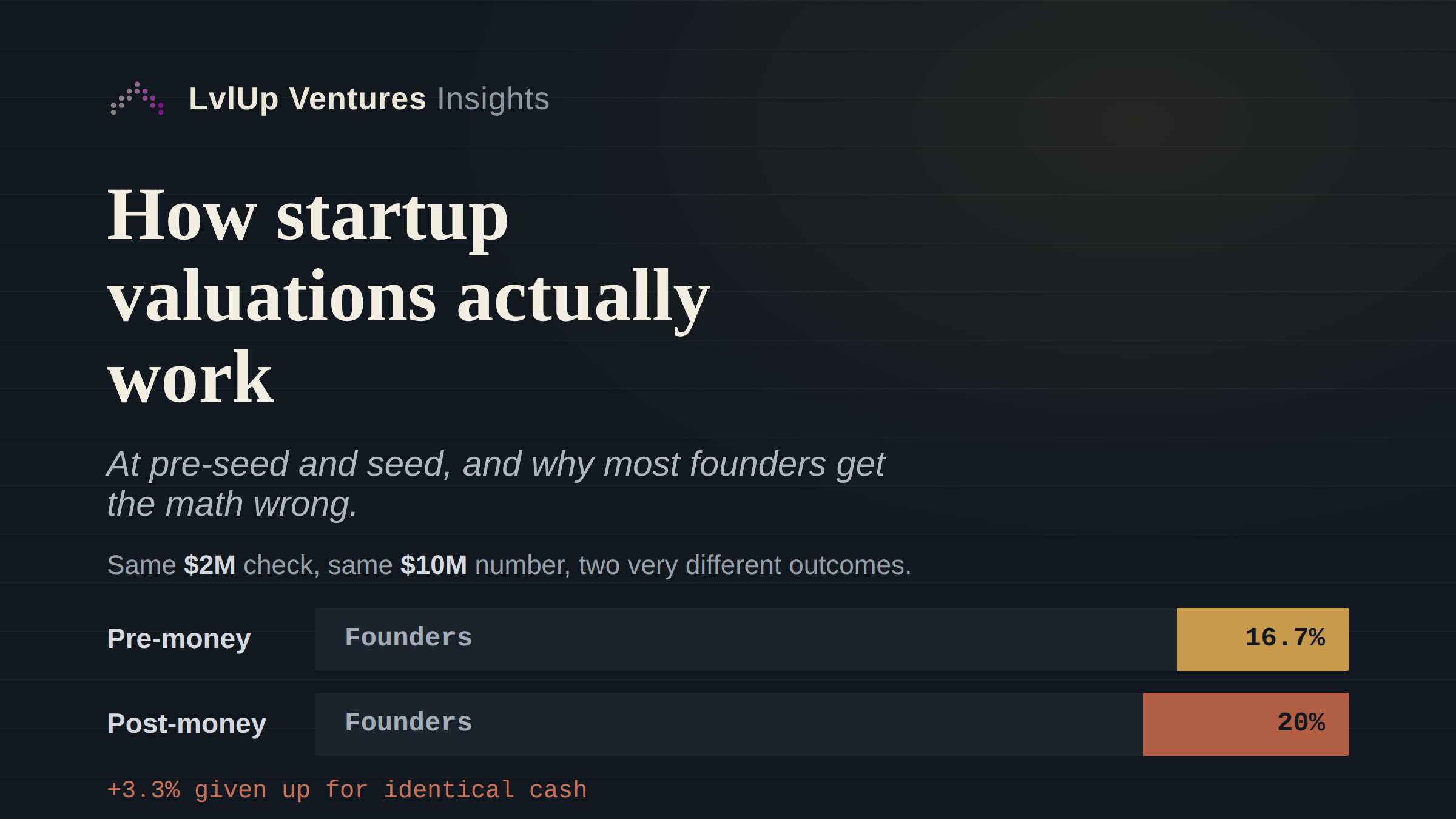
A founder who raises a $500K seed round at a 20% dilution and separately secures $300K in revenue-based financing for customer acquisition arrives at their Series A having deployed $800K of capital while giving up only 20% of equity. The founder who raised the same $800K entirely through equity — at a reasonable early-stage valuation — has given up 30 to 35% before the Series A conversation has even started.
Over the life of the company, across multiple rounds, that gap widens significantly. The founder who used non-dilutive capital strategically retains meaningfully more ownership at exit — and retains more control at every board vote along the way.
What LvlUp Is Building in This Space
Non-dilutive financing is not a new idea, but the infrastructure around it for early-stage founders has historically been fragmented and difficult to access. LvlUp Ventures has invested in building non-dilutive programs precisely because we believe that the best capital strategy for most early-stage founders is not a choice between equity and debt — it is a thoughtful combination of both, deployed at the right moments for the right purposes.
Our non-dilutive funds across B2B SaaS, CPG, and real economy businesses exist because we have seen what happens when founders discover this capital too late. The opportunity cost of that discovery gap is real, and it is measurable in equity points, control, and optionality lost.
The conversation about how to capitalize a company should start at the beginning — not when the equity round is already closing.
#NonDilutiveFinancing #CapitalStrategy #FounderPlaybook #Revenue-BasedFinancing #VentureDebt #SeedStage
LvlUp Ventures backs exceptional founders with both dilutive and non-dilutive capital.
Apply at lvlup.vc






.png)